Retail & Wholesale in the Agri-Food Supply Chain
The retail and wholesale sectors play a vital role in the EU agri-food chain, ensuring that consumers have access to safe, high-quality, and affordable food. These sectors connect millions of consumers with food manufacturers and farmers, forming an essential link between food production and consumption.
Both large and small retailers and wholesalers source products directly from farmers, small and medium-sized food producers, and global food manufacturers. The nature of their negotiations varies widely depending on the size and scale of the businesses involved; for example, a retailer’s negotiations with a local farmer, e.g. to supply a local store, will differ greatly from those between a major retailer and a global manufacturer.
Explore more about how the EU agri-food chain functions and the commercial relationships between retailers, wholesalers, and their suppliers on this webpage.
What Is Behind the Price of a Product?
Retailers and wholesalers price products their based on what their consumers are looking for. Retailers know their customers and try to create an appealing basket of products in terms of price, choice, quality, lifestyle or specialist diet.
Retailers must also respond to what their competitors – which are often just down the road – are doing to win the trust of consumers.
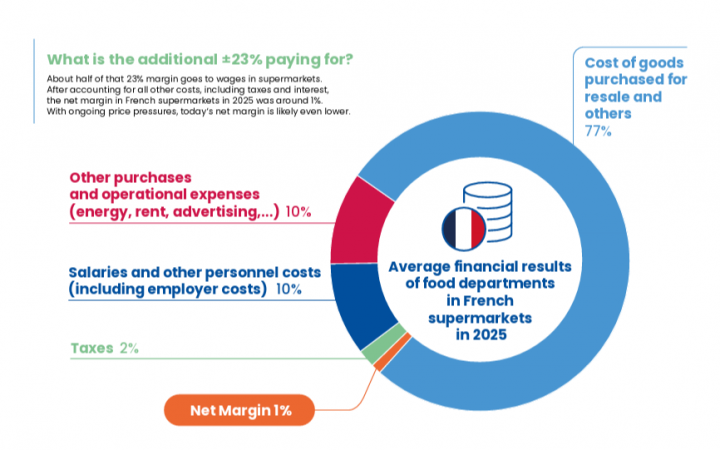
The price a consumer pays reflects what the retailer has paid to its suppliers (about 70% of the consumer price) and what it needs to pay its workers, real estate and other operating costs (energy use, logistics, IT, etc.). This leaves only a very small margin (profit) for the retailer and wholesaler.
For every euro you spend at the checkout:
🔷 77% goes directly to cost of goods purchased for resale
🔷 10% covers operational expenses (energy, rent, advertising)
🔷 10% pays for salaries and personnel costs
🔷 2% goes to taxes
🔷 Only 1-3% remains as net profit
In grocery retail and wholesale, profit can be between 1 to 3 euros for every 100 euros spent.
The Single Market: The Foundation of Food Affordability
EU citizens notice when their shopping becomes more expensive — but often not the benefit they get from retailers and wholesalers negotiating on their behalf.
Retailers work with diverse suppliers across the EU and globally. They compete intensely – often with competitors just around the corner. To survive, they must offer the best value, quality and service.
The Single Market enables:
- Scale and resilience
- Diverse European food products
- Lower prices and more choice
- Innovation and sustainability
Without it, food becomes more expensive and less accessible.
Territorial Supply Constraints: A Barrier to Fair Prices
Retail and wholesale play a central role in providing EU consumers and business customers with choice, innovation and affordable prices. In the context of a prolonged cost-of-living crisis, price remains decisive for households across Europe. At the same time, retailers and wholesalers operate on very low net margins — typically between 1–3% – while facing increasing regulatory pressure and intense competition.
A fully functioning Single Market would allow the sector to operate more efficiently and pass on savings to consumers. However, market fragmentation continues to undermine this objective.
How Territorial Supply Constraints Fragment the Single Market
Territorial Supply Constraints (TSCs) are deliberate practices by certain large manufacturers that prevent retailers and wholesalers from sourcing products freely across borders.
These practices may include:
- Refusing to supply cross-border orders
- Redirecting buyers to national sales offices
- Imposing different packaging, labelling or product variations for identical goods
Such measures create artificial national barriers within the Single Market and enforce price differences between Member States.
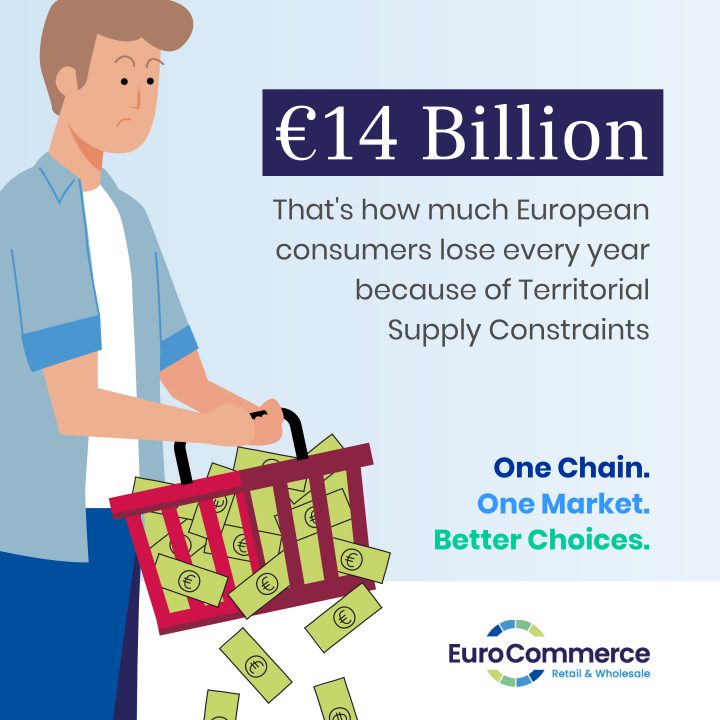
According to a 2020 European Commission study, TSCs cost European consumers at least €14 billion per year across four product categories alone — a burden that is difficult to justify during a cost-of-living crisis.
Retail Alliances: A Tool for Fairer Negotiations
Retail alliances are cooperation agreements between different retailers and wholesalers. Retailers and wholesalers (and many other sectors) use alliances to negotiate better deals, securing lower prices and greater choice.
European retail and wholesale alliances involve retailers from different EU countries.
They do not negotiate with farmers, but focus on global manufacturers of everyday products, negotiating together terms of supply contracts and/or directly buying their products. Global suppliers have significant power in the market for key everyday products we all use, are active all over the world and often fragment the Single Market through territorial supply constraints.
Alliances can help counter this imbalance in market power. They operate within the framework of EU competition rules on cooperation agreements, which recognises the value of buying together to get a better deal. Through competition investigations and a report, the European Commission found that European alliances had no anticompetitive effects on consumers or suppliers. In fact, they found they allowed retailers to offer better prices to consumers.
Retailers and wholesalers thrive on the competition between them – even when there are few players in the market, the low margins in retail and wholesale means they need to make more sales. Offering better prices to consumers increases sales for both distributors and suppliers.
See also:
- Statement on Commission announcement regarding AgeCore and Coopernic – EuroCommerce
- Impact of European Retail Alliances on farmers and SMEs in light of the economic literature – Summary
- Antitrust: Commission closes antitrust investigations into AgeCore and Coopernic
- Revised EU rules confirm the value of retail and wholesale alliances – EuroCommerce
- Retail alliances: defending consumers’ interest – EuroCommerce
- Divided we fall? Grocery retail alliances under the lens of Article 101 TFEU, P. Chauve, R. di Giovanni Bezzi
Unfair Trading Practices (UTP): A Balanced Approach Is Needed
The revision of the Unfair Trading Practices (UTP) framework must carefully assess impacts across the entire agri-food chain.
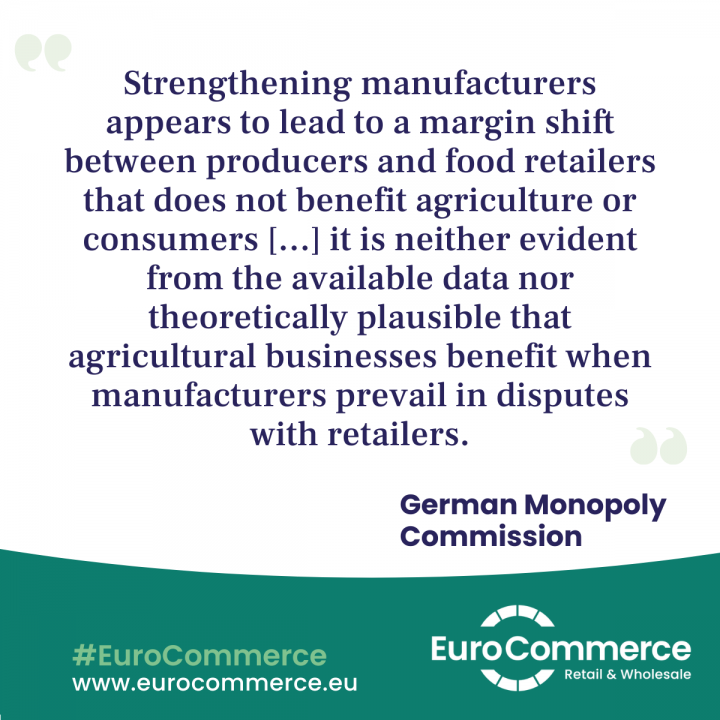
Protecting farmers and small suppliers from abusive practices is essential. However, measures that unintentionally strengthen large manufacturers at the expense of retailers do not automatically benefit agriculture, consumers.
Recent analysis confirms this concern.
This finding highlights an important reality: shifting margins within the chain does not create value. It simply redistributes it, often without helping farmers or lowering prices for consumers.
Any policy intervention must therefore:
- Protect vulnerable actors
- Preserve competition
- Avoid distorting the balance within the value chain
- Safeguard consumer affordability
Debates on UTP, retail alliances, territorial supply constraints and food prices must be considered together.
Find out more here:
- German Monopoly Commission: no cascading effect of prices
- Revision of the UTP Directive – EuroCommerce – Position Paper (2026)
- The Spanish Food Chain Law: Implementation and Judicial Review (2025 Case Study)
- Unfair trading practices: focus on facts, not haste! – EuroCommerce (2024)
- UTP Directive implementation must avoid undermining the single market and harming consumers – EuroCommerce (2021)
- Draft opinion – Section for the Single Market, Production and Consumption – EESC (2025)
More information
European Commission
- Strategic Dialogue on the Future of EU Agriculture delivers its final report to President von der Leyen
- Divided we fall? Grocery retail alliances under the lens of Article 101 TFEU, P. Chauve, R. di Giovanni Bezzi
- Antitrust: Commission closes antitrust investigations into AgeCore and Coopernic
The future of the agri-food ecosystem
- Innovation Talks – Empowering Small Farmers: The Central Role of AI in Future Agriculture
- Joint statement – Stakeholders of all horizons stand ready for the strategic dialogue on the future of agriculture – EuroCommerce (2024)
- EuroCommerce press release on the future of agriculture
- Strategic Dialogue Report
- European Commission press release
- The Agri-Food Transition Pathway – The Retail & Wholesale Perspective
- Cross-border enforcement of Unfair Trading Practices in the agri-food supply chain – EuroCommerce views
- Fit For Future Opinion on the ongoing evaluation of the Unfair Trading Practices Directive – EuroCommerce views
- State ban on purchasing food and agricultural products below production costs – Thünen-Institut für Betriebswirtschaft
Trading practices
- German Monopoly Commission: no evidence of price cascade
- Unfair trading practices: focus on facts, not haste! – EuroCommerce (2024)
- UTP Directive implementation must avoid undermining the single market and harming consumers – EuroCommerce (2021)
Food affordability