The Single Market is still far from complete. In many aspects, the European Union is still a mosaic of 27 different national markets. This overview provides some examples of barriers that retailers and wholesalers face in the Single Market. We ask the Member States, the Commission and the European Parliament to address the barriers identified here. The best way for the retail and wholesale sector to provide jobs and growth is to create a business–friendly environment where there is full competition and consumers can enjoy a wide range of high-quality and safe products.
The main problems that the retail and wholesale sector still faces are:
- Flawed implementation and application of the Services Directive that hinders the freedom of establishment, the free movement of services and the freedom to provide a service;
- National trade laws that hinder business in the way they do business. Often these laws hamper competitiveness of the sector, are protectionist and undermine business models that are genuine and legal business models in other Member States. Particularly concerning are developments in Central and Eastern Europe;
- National requirements that hinder the free movement of goods. Member States do not notify new national technical requirements according to the procedure laid down in Directive (EU) 2015/1535, do not apply the principle of mutual recognition in non–harmonised areas, gold–plate directives, etc.
We also recognise some of the initiatives taken by the Commission to solve some of the examples mentioned in this paper. However, infringement procedures take a long time, are expensive and the outcome is uncertain. For businesses, this takes too long and they might decide to leave or not enter a market. In the end this deprives consumers of more choice, higher service and lower prices.
EuroCommerce welcomes an open dialogue with the Commission, the European Parliament and the Member States to improve the Single Market for Retail. This document is being regularly updated.
If you want to learn more!
Position Paper
Ilya Bruggeman
Director, Digital, Single Market, and Consumer Policy

Ilya and his team deal with digital, payments, single market and consumer policy. They run the IMCO and Payments committees. He worked previously for the Dutch Retail Association and as a public affairs consultant. Ilya is a Dutch national and studied Public Administration at Leiden University in the Netherlands.
Click on the flags to see which barriers to single market these countries face. |
||||
| Bulgaria | Croatia | Czechia | France | Germany |
 |
 |
 |
 |
 |
| Greece | Hungary | The Netherlands | Poland | Portugal |
 |
 |
 |
 |
 |
| Romania | Spain | Horizontal issues | ||
 |
 |
 |
||
Bulgaria
“Euro Adoption Law”
Text of the law – Introduction of the Euro in the Republic of Bulgaria Act
Provisions
• Price freeze until August 2026:
During the period of dual price display, traders who offer goods and services to consumers shall form their prices in good faith and transparently, and any price increase shall be justified by objective economic factors (a legal definition is provided).
Merchants shall, upon request, provide the control authorities with evidence of the existence of objective economic factors. Businesses that form prices in bad faith during the dual price display period will face fines of 0.5–1% of annual turnover, max 1 million BGN.
• Price disclosure for large traders (New Art. 55b (1)):
During the period of dual price display, merchants carrying out activities related to retail in food products, alcoholic and non-alcoholic beverages, tobacco products, non-food products and medicinal products, with a turnover for the previous financial year exceeding BGN 10,000,000 (€ 5 mln), shall be obliged to publish daily by 7:00 a.m. in a machine-readable format allowing data extraction, on their websites information for the day on the individual selling prices of goods offered for sale from the composition of the so called ‘large consumer basket’, determined by the Consumer Protection Commission.
• The Council of Ministers may adopt temporary measures in the event of a significant increase in the prices of essential goods and services (§ 15).
• The law fails to distinguish between Net Income and Margin, creating unrealistic expectations about price stability while imposing cost-intensive obligations on businesses.
Status
• In force.
• A law amending the Euro Adoption Law entered into force on 8 August 2025 – only 2 weeks before entry into force of the Euro Adoption Law. No public consultation or impact assessment, thereby breaching EU standards for transparency and participation.
Offences
• Discrimination between merchants based on turnover from the previous financial year.
• The act does not follow Decisions of The Commission for Protection of Competition, regarding the state intervention in price formation and competitive market environment.
• Risk of disclosure of trade secrets, facilitated price coordination/cartel behaviour.
• Breach of Article 16 of the EU Charter (economic freedom).
• Direct conflict with EU rules on the freedom of pricing and free market competition.
Asks
• The Bulgarian government should ensure that the measures are proportionate and compliant with EU law.
• The European Commission should assess if the law is in line with EU law.
Supply Chain of Agricultural Products and Food Act
Provisions
• Regulates food and agricultural products commerce except tobacco, hemp, rose flowers, beer, wine and animal feed.
• Provides strict form and content requirements for contracts with suppliers (disregarding existing UTP regulations).
• For 10+ stores retail chains, mandatory proportion of Bulgarian products: More favourable treatment of local products – 50% of the fresh produce (fruits and vegetables, meat, eggs, honey) and 80% of dairy products (milk, Bulgarian yoghurt, white cheese, cottage cheese etc.) have to be manufactured by Bulgarian producers or processors from 100% Bulgarian milk.
• Price transparency: Retailers with a turnover of over 20 million BGN obliged to publish price lists on its website in machine-readable format, provision of price data to regulators, updating the information in real time.
• Maximum trade mark-ups on certain products, defined by the government after entry into force of the law and offered by supply chain entities are subject to maximum limits. For retailers, the maximum mark-up is 20% of the purchase price. disregarding other expenses. This maximum mark-up is reduced to 10% for agricultural products sourced from third countries. This regulation applies exclusively to traders with an annual turnover exceeding 20 million leva in the preceding calendar year; Additionally, mark-ups by over BGN 20 million turnover retailers must be equal for identical products in the same product group.
• For over BGN 20 million turnover retailers – quantity limit for promotional items: The quantities to which end customer promotions apply may not exceed 25% of the contractually agreed forecast annual volume between the supplier and retailer and must be defined in advance.
• Consumer discount limitation:
The discount granted may not exceed 10% of the previous sales price, of which no more than half may be charged to the supplier (i.e. max. 5% of the previous price);
• All advertising campaigns require a preliminary delivery schedule and prior agreement.
• New, very general and arbitrary UTP and much harsher sanctions:
Acts or omissions towards suppliers that are contrary to good commercial practice and are or could be detrimental to the interests of the supplier are prohibited;
Cancellation of orders for perishable agricultural products and foodstuffs by the buyer at such short notice that the supplier cannot reasonably be expected to market or use these products in any other way;
A notice period of less than 30 days is always considered to be short notice;
The UTP according to Art. 3 (2) of the UTP Directive (conditional UTP) must not only be clearly and unambiguously agreed (as is the case now), but must also be “fair”;
UTP penalties: from between BGN 50,000 and BGN 300,000 to 5% of the total annual turnover.
• The retailers will have 3-month period to re-adapt their contracts with the retailers to comply with the new regulation.
Offences
• Principle of open market economy and free competition (Art. 119 of the TFEU + Art. 16 of the Charter of Fundamental Rights of the EU);
• Principle of free economic initiative (Art. 19 of the Constitution of the Republic of Bulgaria);
• Principle of non-discrimination – numerous discriminatory provisions:
Between small and large traders (over 20 million turnover; over 10 sites) – Art. 11, Art. 20 of the draft; – between traders and producers – the latter have no limit on mark-ups – Art. 15, 17, 19 of the draft;
Between traders (obligation for 50% BG goods + penalty) and producers (no ban on exporting BG products);
Violation of the Principle of Free Movement of Goods and Freedom of Establishment (Art. 34 and Art. 49 of the TFEU);
• Principle of restriction of fundamental freedoms only by law: products are determined by the Council of Ministers Art. 15, 17 of the draft → significant legal uncertainty
• Principle of proportionality: state intervention only with very well-argued justification + proven benefit (in this case there is no impact assessment, and there is negative experience from other countries – Hungary, Romania, Greece, Croatia, including for consumers); regulatory regimes – are introduced only when justified → unnecessary commitment of industry and state resources, increase in the share of the shadow economy) Art. 6, Art. 13 of the draft.
• Principle of equality between the parties to a commercial contract: The UTP Directive has already introduced derogations. The draft without any justification introduces new prohibitions + a drastic increase in sanctions – § 5 – amendment to the LPC.
Status
• A draft law proposed by the Agricultural Ministry. It has completed the Public Consultations phase and was submitted to Parliament (autumn 2025).
Asks
• The Bulgarian government should ensure that the measures are proportionate and compliant with EU law.
• The European Commission should ensure no national measures are introduced considering coming amendments in UTP directive.
Competition Protection Law: Incorrect Transposition of Directive on Misleading and Comparative Advertising
• Background: Directive 2005/29 on Misleading and Comparative Advertising applies only to B2C; Directive 2006/114 only to B2B. European Court of Justice ruled that national authorities cannot expand Directive 2005/29 to B2C.
• In Bulgaria:
Directive 2005/29 – Consumer Protection Act (CPA).
Directive 2006/114 – Competition Protection Act (CoPA).
Provisions
• Penalty for misleading advertising is up to 10% of annual turnover – same as for cartel violations.
• No distinction in impact between cartel and misleading advertising is reflected in the law.
• Consumer Protection Commission (CPC) Methodology:
Antitrust – based on turnover of affected products.
Unfair competition – based on total annual turnover.
Offence
• Breach of the principle of proportionality.
• CPC enforces CoPA and penalizes misleading B2C advertising, contradicting both directives.
• Double sanctions violate Article 50 of the EU Charter of Fundamental Rights.
Asks
• The Bulgarian government should ensure that the measures are proportionate and compliant with EU law, amend CoPA to clearly state that misleading advertising applies only to B2B, adjust sanctions (fixed penalty ranges or revise CPC Methodology to base fines only on turnover related to the affected product/service).
• The European Commission should assess if the law is in line with EU law.
Unlawful Ordinances of the Food Safety Agency
Ordinances about restrictions on the EU import of Fruits and Vegetables were issued in 2020.
Easter eggs
• Every Easter, the Bulgarian Food Safety Agency is issuing Ordinance about restrictions to the non-Bulgarian eggs. The eggs are subject to additional controls and laboratory tests; usually of 5 or 6 working days.
• Despite the Bulgarian government’s stated objective to decrease the administrative burden in the State of emergency and the Emergency Epidemic State, the measures and the politic of Stimulus for the national Production would achieve the opposite effect and even more crucially in a time when a fall in investments in Bulgaria is expected.
Offences
• Breach of Articles 34-36 of the TFUE related to the free movement of goods in the EU.
Asks
• The Bulgarian government should ensure that the measures are proportionate and compliant with EU law.
• The European Commission should assess if the law is in line with EU law.
Agri-Food Chain Management Act
The bill establishes a common legislative framework regulating the competent authorities that conduct policy in this field, perform official control over the components of the agri-food chain and carry out risk assessment along the agri-food chain.
Provisions
• Art. 43 of the Act contains prohibition on the return of food from wholesale and retail outlets to production sites, except in the cases referred to Art. 19 of Regulation (EC) No. 178/2002 (EU Basic Regulation).
• Daily needs for return of food mainly from the warehouses, e.g. due to incorrect labelling, wrong delivery – addressee, quantities or products, non-compliance with contractual terms, etc.
• Good quality food and safe for consumption.
• No need for disposal.
• Almost no possibility for donation (restrictions in the VAT Act, the food is not suitable for donation (e.g. wrong labelling), the food is not property of the business operator. i.e. he is not entitled to transfer it to a third entity)
• Significant expenses and losses for the business.
• Unjustified waste of food (not tolerated by the World Health Organization and the European Commission).
• Increase of the administrative burden in a time when a fall in investments in Bulgaria is expected.
• The prohibition could also undermine the warranty rights of wholesalers and retailers.
Offences to the free movement of goods
• Creation of unjustified internal market barrier Art. 28 of the Treaty on the Functioning of the European Union (TFEU)
• Quantitative restrictions on imports or at least measures having equivalent effect, hindering the on-line trade between member states (ECJ, Case 8/74 (“Dassonville”)), according to Art. 34 of the TFUE.
• No justifications on overriding reasons of public interest under Art.36 of the Treaty on the Functioning of the EU (like in particular tax controls, the protection of public health, the protection of the fair trading and reasons for consumer protection)
• The prohibition applies (according to its wording) not explicitly to cross-border trade, but practically would affect it the most.
• The exception to the Prohibition (food may only be returned if considered unsafe within the meaning of Art. 19 of the EU basic regulation (return of food in case of recall/withdrawal)) lacks logic, since the unsafe food can be return while the safe one cannot.
Offences to the EU Charter of Fundamental Rights
• Breach of Art. 17(1) of the EU Charter of Fundamental Rights (everyone has the right to own, use, dispose of and bequeath their lawfully acquired possessions). The obligation to comply with property rights in accordance with Art. 17 EU Charter of Fundamental Rights applies in accordance with Art. 51, para. 1, sentence 1 EU Charter of Fundamental Rights, on the one hand, to the European Union and its institutions and, on the other hand, to the member states. This also includes the right to sell or return food to the manufacturer. Therefore, there is an interference with the right of property.
Offences to the freedom to conduct a business
• Hindrance of the freedom to conduct business as per Art. 16 of the EU Charter of Fundamental Rights.
• Violation of the right of property of the food business operator.
• Interference with the entrepreneurial freedom to trade goods freely and to sell them back to the manufacturers, as per Art. 16 of the EU Charter of Fundamental Rights (entrepreneurial freedom (which according to the legal practice of ECJ includes, among other things, the commercial and industrial manufacture of products) is recognized in accordance with Union law and national law and practice).
• Contradiction to the principle of proportionality which requires any restrictions and administrative regulation to be undertaken only insofar as they are justified with regard to the protection of public interest (as per practice of ECJ).
Offences to the Directive (EU) 2015/1535 and the standstill period of Notification 2020/36/BG by TRIS
• Despite prolongation of the standstill period and in breach of Directive (EU) 2015/1535, the Act was adopted and entered into force.
• Pursuant to EU case law the failure to respect the standstill period is a material procedural defect rendering the technical regulation at issue inapplicable and unenforceable against individuals.
• No actions on behalf of the Bulgarian state have been taken, since this provision is adopted with no substantial changes
Comparison between notified to TRIS (EK)/ adopted version
Article 48 43. It is forbidden to:
place on the market foods of animal origin obtained from emergency or sanitary slaughter, for which no official control has been carried out;
return food from wholesale and retail outlets to production sites, except in the cases referred to in Article 19 of Regulation (EC) No 178/2002;
place on the market food unfit for human consumption.
Asks
• The Bulgarian government should comply with the Directive (EU) 2015/1535 and amend the measure in accordance with the Commission detailed opinion.
• The Commission should ensure that this act is in line with EU law.
Fiscal control on goods with high fiscal risk. Goods declaration system
Provisions
• Requires prenotification of foodstuff from other EU Member States before entering Bulgarian territory
• Companies are obliged to declare every transaction and every order of different foodstuff, also for transactions within Bulgaria. Some of the issues to inform: price, amount, etc.
• If the trader identifies differences between the information and the information provided by the supplier, the authorities must inspect the transport. The unload is stopped.
Offence
• Prenotification of food products is not compatible with Article 9(7) of Regulation (EU) 2017/625 of the European Parliament and of the Council on official controls on the agri-food chain (‘the Official Controls Regulation’)
• The measure was not notified according to the notification procedure established by Directive (EU) 2015/1535
Status
• In force from 1 January 2025.
Asks
• The Commission should assess the compatibility of the measure with EU law
• The Bulgarian government should bring the measure in line with EU law and notify the draft law according to the notification procedure established by Directive (EU) 2015/1535
• The Commission should prevent that prenotification procedures become the norm in the EU and undermine the free movement of goods on a structural basis, i.e. historically Czechia and Hungaria also introduced prenotification procedures for food.
Electronic meal vouchers interchange fees
Provisions
• Electronic meal vouchers are tax free up to the amount of BGN 200 per month per employee. The vouchers allow employees to pay for food at a network of merchants and can be redeemed at POS terminals.
• Since 01.07.2024 electronic meal vouchers have replaced the previously used paper-based vouchers, requiring the implementation of new processes within the merchant’s organizations.
• The use of the new cards and mobile applications has led to significant increase of expenses for the merchants since the applicable interchange fees fall outside of the scope of Regulation (EU) 2015/751 of the European Parliament and of the Council of 29 April 2015 on interchange fees for card-based payment transactions and are highly elevated compared to usual card transactions. The elevated financial burden is born solely by the merchants and has inflationary potential vis-à-vis consumer prices.
• Bulgarian government relies on discretion under Art. 209a of the Corporate Income Tax Act to limit the commissions due between the participants in the electronic meal voucher market.
• National measures would be likely to lead to significant barriers to the completion of the internal market in the area of meal vouchers payments.
• Interchange fees are applied between the meal voucher service providers and the card-issuing payment service providers belonging to a certain payment card scheme. Interchange fees are a main part of the fees charged to merchants by meal voucher service providers for every card-based payment transaction. Competition between payment card schemes to convince meal voucher service providers to issue their cards leads to higher rather than lower interchange fees on the market, in contrast with the usual price-disciplining effect of competition in a market economy. In addition to a consistent application of the competition rules to interchange fees, regulating such fees would improve the functioning of the internal market and contribute to reducing transaction costs for merchants and consumers.
• The existing wide variety of interchange fees and their level prevent the emergence of new pan-Union players on the basis of business models with lower or no interchange fees, to the detriment of potential economies of scale and scope and their resulting efficiencies. This has a negative impact on merchants and consumers and prevents innovation. As pan-Union players would, as a minimum, have to offer meal voucher service providers the highest level of interchange fee prevailing in the market they want to enter, it also results in persisting market fragmentation. Existing domestic schemes with lower or no interchange fees may also be forced to exit the market because of the pressure from meal voucher service providers to obtain higher interchange fees revenues. As a result, consumers and merchants face restricted choice, higher prices and lower quality of payment services, while their ability to use pan-Union payment solutions is also restricted. In addition, merchants cannot overcome the fee differences by making use of card acceptance services offered by meal voucher service providers in other Member States. Specific rules applied by the payment card schemes require the application of the interchange fee of the ‘point of sale’ (country of the merchant) for each payment transaction, on the basis of their territorial licensing policies. This requirement prevents acquirers from successfully offering their services on a cross-border basis. It can also prevent merchants from reducing their payment costs to the benefit of consumers.
Asks
• The European Commission should assess the possibility to initialize widening of the scope of the Regulation (EU) 2015/751 of the European Parliament and of the Council of 29 April 2015 on interchange fees for card-based payment transactions.
Croatia
Price caps & price surveillance
Provisions
- Price cap for currently 70 different FMCG products.
- Additional burden of publishing price lists daily on official website, and to display “anchor price” valid on 2 May 2025 on the shelf.
Status
- The Price Cap law was temporary, but it was extended, not only in the duration, but also in the products covered (30 new products covered as of 1 December 2025).
- Ministry is not taking into account changes in the purchase prices on the global level and adjusting the caps, which was also initially promised. Interestingly, the limitation of price of fuel was recently removed.
Asks
- The Commission should analyse if the restrictions are lawful, justified and proportionate and if the policy objectives of this law cannot be met by other less burdensome means.
- The Commission should look at potential disruptions and effects on the supply chain and other similar products.
Trade Act: closing of stores on Sundays
- Stores (as defined in law as ‘’store venue’’ or store object’’) are closed on Sundays and a store (object) can work maximum 16 Sundays in one year. But the stores must be closed on National Holidays, without any exceptions.
- ‘’Object’’ is also a warehouse and cannot do absolutely anything on Sundays when they are closed, including:
- Construction work, repairs, inventory, cleaning or the warehouse/store object being ‘open’ for any other activities
- Online sale is in general allowed but any preparation of products in store/warehouse for delivery is not allowed.
- Food retailers are not any more allowed to prepare fresh products on Sunday so they can sell them on Monday. Additional problems arise when Sundays and holidays connect, and the gap is more than one day.
Status
- Applies from 1 July 2023. In recent opinion Ministry excluded logistic and distribution centres from the prohibition to operate but only if they are separate from the store and are only used for supplying the stores, not for deliveries to customers.
Asks
- The Commission should analyse if the restrictions are lawful, justified and proportionate and if the policy objectives of this law cannot be met by other less burdensome means.
Czechia
Significant Market Power Act
Act No. 395/2009 Coll., on Significant Market Power in the Sale of Agricultural and Food Products and Abuse Thereof
Amendments
Acts No. 50/2016 Coll.; 104/2017 Coll., 183/2017 Coll., 254/2020 Coll. 261/2021 Coll., 417/2021 Coll. And 359/2022 Coll.
Definition of significant market power
The regulation applies to buyers with annual turnover exceeding EUR 2 million. In addition to buyer annual turnover, supplier annual turnover is also of decisive importance for determining the scope of the Directive in relation to a specific business relationship. The buyer has significant market power if:
|
Buyers´ annual turnover is |
and Supplier’s annual turnover is |
|
min EUR 2 million |
max EUR 2 million |
|
min EUR 10 million |
EUR 2 million – EUR 10 million |
|
min EUR 50 million |
EUR 10 million – EUR 50 million |
|
min EUR 150 million |
EUR 50 million – EUR 150 million |
|
min EUR 350 million |
EUR 150 million – EUR 350 million |
The buyer has also significant market power if Buyer’s annual turnover in the Czech Republic exceeds CZK 5 billion. According to the interpretation of the Office for the Protection of Competition, the rule that persons in a legal relationship, each with a turnover of more than EUR 350 million are excluded from the scope of the Act also applies.
On 1 January 2023, an amendment to the Act came into effect. It significantly expands the Act’s scope both in terms of (i) who is affected as well as (ii) the obligations it imposes. All purchasers of food and agriculture products need to reassess whether they are now subject to the amended Act and revise their internal rules and contractual relations with suppliers accordingly.
Other provisions
- The Act contains a general clause prohibiting any abuse of significant market power. Significant market power is defined as a position allowing the buyer to force an unjust advantage on suppliers regarding the purchase of food products or the receipt or provision of related services.
- Also, other activities can be considered as abuse according to the Czech Antimonopoly Office’s evaluation, leading to a broad interpretation.
- Implementation of supplier audits by retailers.
- Payment targets are set for all supplier contracts at 30 days after delivery.
- Companies whose annual financial statement must be, according to law, annually reviewed by an auditor must publish information on payment terms for their suppliers.
- There is a list of prohibited activities which is only illustrative and thereby creates legal uncertainty.
Offences
- The law especially discriminates large foreign retailers and wholesalers vis-à-vis local players. The law does not foresee an objective definition of market power that takes all factors into consideration (besides a random turnover threshold).
Status
- In place. Latest amendment came into effect in January 2023.
- On 23 July 2021, the European Commission launched an infringement proceeding against Czech Republic that failed to notify the complete transposition of the UTP Directive which should be implemented via the SMPA.
- Spring 2023 – the fast-track investigation on high prices of food by the Office for the Protection of Competition.
Asks
- The Czech government should ensure the law is proportionate, does not undermine freedom of contract and give anti-competitive advantages to certain operators in the supply chain.
- The European Commission should assess if the law is in line with EU law.
France
EGALIM III – Trading relations with producers – Unfair Trading Practices Directive
Tendant à renforcer l’équilibre dans les relations commerciales entre fournisseurs et distributeurs – (Loi Descrozaille)
Provisions
- The law restricts the freedom of retailers to use the Single Market by imposing the application of French law in any negotiation involving products destined for French retailers’ shelves.
- The idea is to support French producers against retailers.
- It gives huge powers to the manufacturers. Mainly to stop supplies and cancel the contract. This right in case producers and retailers do not find a common ground. This power is given only to suppliers. This affects central purchases and retail alliances.
- Retailers are refrained from making joint purchases with retailers present in other countries. This makes easier for multinational brands to establish Territorial Supply Constraints (TSCs) and obstacles to the free movement of goods. It increases unnecessarily the final price of the good for the consumer.
- It can result in an extension of the delivery times and in a restriction on the choice of products for consumers.
- French retailers and wholesalers are obliged to source an identical product available in neighbouring markets for a higher price than it is available for in the French market.
- The French Ministry of the Economy has repeatedly fined retail alliances or companies legally established in another EU countries for not respecting the French law, although these alliances legally source under the rules of other member states (Belgium, Spain).
Offences
- It constitutes a restriction to the free movement of goods in the EU.
- The Commission should assess the proportionality of this law and whether it’s in line with EU law, mainly Single Market and Competition law.
Status
- In force since 22 March 2023.
Asks
- The Commission should ensure the application of Single Market principles, including parallel importing, by all operators, including suppliers, so that consumers can truly benefit from it.
- The Commission should assess the proportionality of the measure and its impact on consumers.
General obligation of conformity
Article L212-1 Consumer Code
Provisions
- Currently importers must ensure that all products placed on the European market are compliant and safe.
- For harmonised products, they must ensure that the appropriate procedures have been applied by the manufacturer.
- For non-harmonised products, compliance with national regulations and the obligations listed in order of importance in the General Product Safety Directive applies.
The French GIFI ruling says
- Imported goods must be inspected after their arrival in the country, consequently, the French authorities do not recognise test reports prepared by accredited organisations outside the EU or even outside France.
- Failure by the importers to carry out their own inspection goes against French law. As a result, importers are obliged to carry out their own inspections in France.
- To overcome the difficulties of applying the principle of mutual recognition, the European Commission undertook its codification. Therefore, Regulation 765/2008 stipulates that Member States must take account of the reports issued, provided that the laboratories were audited by an accredited organisation.
- These laboratories could therefore be in China – examples are LCIE and UTAC labs whose Chinese subsidiaries received accreditation from the COFRAC (the French accreditation body) where their reports must be taken into account by the market surveillance authorities.
- Yet, in France, the GIFI arguments for the need to test products in France are further confirmed by recent audits -excerpt from a letter from the DGCCRF (audits of the regional directorates of the DGCCRF – 2015 – 2014 – 2013).
- Consequently, most businesses act in compliance with these national requirements and very few of them use the right of recourse available at national or European level.
Offence
- It violates the mutual recognition principle, as established in Articles 34-36 of the TFEU.
Status
- In force.
Asks
- Greater enforcement of the Regulation 765/2008: Member States must take account of the reports issued, provided that the laboratories were audited organisations outside the EU or even outside France.
- Better recognition of the presumption of conformity applied on the European market. It also implies a better recognition of tests of compliance by certified laboratories prior to importation.
- Find an effective way to step up the application of the principle of mutual recognition, specifically to recognise test reports issued by market surveillance authorities
- Create a European base of definitions and responsibilities that is not open to interpretation.
- Based on the compromises obtained during the legislative process for the draft Safety Package, we propose to level the playing field around on key issues sur as the definition of “placing on the market”.
Commercial Urban Planning
Provisions
- Opening a store in France takes at least 6 months for a renovation and several years for establishment.
- Establishment permit procedure is particularly obscure, since the French public authorities require a large number of studies, evaluations and justifications. Additionally, there has been an increase in commercial urban planning reforms in the recent years, which makes the opening of and operating physical stores more difficult.
- As a result, there is an increase in the costs. In addition, the lack of clarity of regulatory tools may also deter operators from entering the market.
Freezing of commercial areas
Provisions
- The 2018 ELAN Law allows the State representative of a department to suspend an authorization procedure required to launch commercial exploitation projects ( 157 of the ELAN law codified at art. L.752-1-2 of the French Commercial Code). It concerns inter alia new retail businesses having a commercial area of more than 1,000sqm, and the extension of the commercial area of a retail business beyond 1,000sqm. The procedure is detailed by decree.
Offense
- The provision constitutes a substantial national restriction on the freedom of establishment of shops guaranteed by Article 49 TFEU.
- The prohibition is discriminatory because it covers only retail shops with more than 1,000 m².
Status
- In force.
Asks
- As a barrier to establishment in France, the measure should be monitored and its justification and proportionality assessed.
Label on construction and wall/floor decoration products of VOC emission class (A+, A, B, C, D)
Environmental Code Art.L221-8: Art.180 of Law 2010-788 of 2010 July 12th ‘providing National Commitment to the Environment (Law “GRENELLE II”)
Decree no 2011-321 of 23 March 2011 and Order of 13 May 2011 – relating to the labelling of construction products, wall or floor coverings and paints and lacquers with their volatile pollutant emissions.
Provisions
- Products need to be relabelled specifically for the French market, increasing costs without clear benefits to consumers.
- The decree implements a mandatory emission classification label of all construction products and other products used, exclusively or otherwise, indoors, based on emission testing, starting in 2012.
- The decree introduces an obligation to indicate on a label, placed onto the product or its packaging, the volatile emission pollutants when the product has been incorporated into the building or applied on a surface.
- The label on the products includes a large letter indicating the highest (worst) emissions class of the listed individual substances and the TVOC.
- The label must be 15 mm x 30 mm minimum, coloured or black & white. It includes a mandatory wording, in French: “Indoor air emissions” (“émissions dans l’air intérieur”).
Example
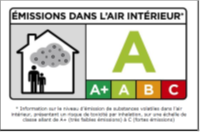
The label must be accompanied with a legible sentence, in French:
English: “*Information about the indoor air emissions of volatile substances posing an inhalation toxicity risk, on a scale from A+ (very low emissions) to C (high emissions)”.
French: “*Information sur le niveau d’émission de substances volatiles dans l’air intérieur, présentant un risque de toxicité par inhalation, sur une échelle de classe allant de A+ (très faibles émissions) à C (fortes émissions) “.
Emission classes are based on their emissions after 28 days tested in line with ISO 16000 standards and calculated for the European Reference Room.
Possible heavy penal sanctions if the label is missing: €1,500 per product without label (€7,500/ product if the company is prosecuted).
Status
- In force.
Asks
- The French government should abolish this unnecessary mandatory national labelling requirement that fragments the internal market and hinders the free movement of goods.
- Besides, the different classes may not be understood by customers in various countries. The classes may be in contradiction with other existing rules in other countries.
- The Commission should examine which mandatory information requirements are really necessary and allow businesses to provide ‘nice to know’ information via modern digital technologies without overloading consumers with information they cannot absorb.
Label to inform the consumer that the product falls within waste-sorting instructions
Decree 2014-1577 of 23 December 2014 relating to the common symbol of recyclable products which are subject to waste-sorting instructions under the Extended Producer Responsibility (packaging, paper, textile, furniture…).
+ TRIMAN unified recycling signage and marking system, User’s Handbook (V2. December 2015)
Provisions
- Products need to be relabelled specifically for the French market, increasing costs, fragmenting the internal market and without clear benefits to consumers.
- The Decree is providing an obligation, as from 1 January 2015, to label with following label all “recyclable” products, covered by an Extended Producer Responsibility scheme in France and subjected to specific waste-sorting instructions:
- Recyclable products = “Products that can be effectively recycled considering the actual technical and economic conditions”. The label must be 1cm² minimum, visible, legible, indelible, not hidden.
- The EEE, batteries and household chemical waste are excluded as they must already bear a crossed-bin label:
- Alternatively, if not applied directly on the product, the symbol may appear on the packaging, the instruction manual or any other media, including dematerialized.
- NOTE: Even though the decree itself does not contain any sanction in case the label is not applied, (sanction planned in draft text was removed after TRIS Notification and comments from Commission and other countries), the legal risk is real and possibly high if symbol is not properly used.
- In the final French Decree published in 2014 in the French Official Journal, the sanctions initially included in the draft notified to the EU Commission were removed due to issue of comments by Belgium, Italy, Netherlands, Slovakia and issue of detailed opinion by Commission, Luxembourg, Portugal, Spain, United Kingdom.
- But it appears that France has found a way to go around the problem by referring to a general provision present in the Environmental Code. That provision provides heavy penalties (fine up to € 100.000 and 2-year imprisonment) in case of non-compliance to certain requirements of the same Code, including the one referring to “Triman” symbol. This is clearly specified in the TRIMAN User’s Handbook (Dec.2015) edited by the Ministry of Environment. That is creating a very high legal risk for EU companies selling concerned products on the French market. If we consider that the French decree states that there must not be labels confusing with the French symbol, the difficulties will come if one product is submitted to various labels due to various legislations or standards within.
Status
- In force
- In France 2023 the Commission opened an infringement procedure against France on the TRIMAN logo.
- In November 2024, the Commission issued a reasoned opinion to France.
- In July 2025, the Commission decided to refer the matter to the Court of Justice of the EU.
- Consequently, the French government reportedly intends to propose to withdraw the obligation as of 12 August 2026.
- The decision of the French government to abolish this unnecessary national labelling requirement that fragments the internal market and hinders the free movement of goods is welcome.
Asks
- The Commission should examine which mandatory information requirements are really necessary and allow businesses to provide ‘nice to know’ information via modern digital technologies without overloading consumers with information they cannot absorb.
Article 13 of the law against waste and for the circular economy (AGEC Law)
Provisions
- Pursuant to art. 13 of the law against waste and for the circular economy (AGEC law) and art. L.541-9-1 of the French Environmental Code, consumers should be informed of environmental characteristics and qualities, including the presence of dangerous substances or endocrine disruptors that could have an impact on health and the environment.
- The AGEC law provides for the possibility of extending and strengthening information obligations provided for in the REACH regulation and the regulation for classification, labelling and packaging of chemicals (CLP).
Offense
- The requirements restrict the free movement of goods (art. 34 TFEU).
- The requirements on information to consumers go beyond EU rules: providing information on a label rather than on-demand, providing information on substances of very high concern (SVHC) but also substances having a comparable concern which are not on the SVHC list, no concentration threshold, etc.
Status
- In force after notification in 2020 under TRIS (here for waste-generating products and here for endocrine disruptors).
Asks
- The Commission should ensure that French law is aligned with EU law.
French environmental labelling for textile clothing products
Decree on the methods for calculating and communicating the environmental cost of textile products.
Order on signage and methodology for calculating the environmental cost of textile clothing products.
Provisions
- The French Ministry of Ecological Transition and its agency ADEME are developing an environmental labelling scheme that would apply voluntarily to textile apparel products sold on the French market.
- The labelling scheme is based on an impact assessment that evaluates the environmental cost of a product based on a set of criteria, that are under development.
- The criteria include inter aliathe amount of water and chemicals used in production, the physical durability of garments, microplastic shedding, and the export of textile waste outside the EU.
- A final criterion, the so-called durability coefficient (also dubbed extrinsic durability), includes a series of metrics that now include the size of a product portfolio of a retailer (50%) and the incentivisation to repair that product (50%), which may mostly penalise low-cost goods.
- The environmental cost will be calculated either with a tool developed by the French government called Ecobalyse, or with other company tools that capture primary or secondary data on the criteria to be evaluated. A given garment will then have a score applied to it, ranging from 0 to infinity (in theory).
- The score will need to be applied in-store and online circa to the price of the garment.
Offences
- The product environmental footprint category rules (PEFCR) for Apparel and Footwear are currently being developed by experts in the PEF Technical Secretariat. This work is supported by the European Commission’s DG Environment.
- The PEFCR is a harmonised approach that would apply (voluntarily) across the EU.
- The French criteria go above and beyond PEF in important ways, most notably when it comes to addressing the extrinsic durability of apparel products.
- Extrinsic durability is not part of the future list of ecodesign criteria that will apply to apparel products under the ESPR Delegated Act for Textiles.
- France is moving ahead with a labelling scheme for textiles at the same time as DG GROW is revising the EU’s Textile Labelling Regulation.
Status
- In force – decree and order adopted on 6 September 2025 (published on 9 September 2025).
- The draft decree and order were notified to the European Commission in February 2025, triggering comments from the Commission that the labelling scheme should remain voluntary and review criteria related to the durability coefficient, which is now the case.
Asks
- The French Ministry of Environment considers the French rules to be compliant with EU law as the labelling is voluntary and the durability coefficient has been updated to take into account the concerns raised by the Commission.
- As the environmental labelling scheme may contribute to the fragmentation of rules concerning product labelling in the Single Market, we ask the Commission to ensure that, in the future, the French rules remain voluntary and aligned with EU environmental labelling rules.
Draft law aimed at reducing the environmental impact of the textile industry
Provisions
- The draft law, as adopted by the French Senate in June 2025, aims to tackle “ultra-fast fashion” practices.
- It introduces eco-modulation of financial contributions as part of the extended producer responsibility scheme for textiles (art. 2), it prohibits advertising and influence marketing for ultra-fast fashion products and brands (art. 3), it introduces a tax on non-EU marketplaces for packages below 2kg imported into France and sent directly to the consumer (art. 8).
Status
- The bill has been notified to the European Commission, which issued two detailed opinions in September 2025. Sweden also issued a detailed opinion while other Member States expressed concerns through comments.
- The status quo period has been extended to end of December 2025 to let France reply to the points raised.
- A joint parliamentary committee (committee gathering MPs and Senators in order to reach an agreement on a common version) is scheduled to meet early 2026.
Offenses
The Commission’s opinions are broadly aligned with EuroCommerce’s comments. The offenses include the following:
- The country-of-origin principle established in the e-commerce directive (according to which information society service providers are subject to the law of the Member State in which they are established). The Commission finds that the documentation requirements, the display of awareness messages and country of manufacture, and the advertising/promotion bans could indeed conflict with this principle.
- The Commission notes that the penalties under the EPR seem disproportionate in light of the provisions of the Waste Framework Directive.
- Similarly, the Commission observes that the environmental cost methodology, which was to remain voluntary in order to comply with European law, would become mandatory for fast fashion products, contrary to the commitments made by the French authorities.
- Finally, the Commission is concerned about the non-compliance of the small parcel tax with the internal market and the customs union.
- Other points raised by the Commission include gaps in definitions, potential discrimination, and possible restrictions on the free movement of goods.
- The Commission also refers to various European initiatives currently underway or planned in the areas of environmental labeling, sustainability, mandatory information on the origin of textiles, and the calculation of environmental impacts.
Asks
- The Commission should ensure alignment of the French draft law with EU rules.
Germany
State planning laws for state plans/state planning programs and regional plans
Establishment restrictions – urban/commercial planning
- The establishment of any business (incl. industry, services) has to be in line with the German system of spatial planning and zoning legislation consisting of different federal, state and regional laws and regulations.
- This legislative framework – including the planning rules – aims to ensure the vitality of city centres and an optimal supply for the population of all regions in Germany. All retail formats can be established in city centres, including large scale retail. Large scale retail must be subject to defined rules based on the usually considerable external effects or attracting force: The large-scale retail may not impair neighbouring municipalities (Prohibition of Impairment), must be situated at integrated urban locations (Integration Principle) and its catchment area may not materially exceed the city and surrounding area (Congruency Principle).
- Large scale retailers who wish to build outside central supply areas have to limit their centre-relevant range.
- Regional plans often restrict the municipality’s right of planning/permitting retailers of more than 1200 m2 floor space and 800 m2 sale space with the reason that they can have a negative impact on the supply structure for consumers in the region.
- Exceptions are possible subject to a case-by-case assessment following a standardised procedure.
- The European Commission and two companies claim that in some regions the urban planning rules conflict with the principle of freedom of establishment and infringe the Services Directive by applying economic criteria to allow retail permits.
Asks
- The Commission should carry out regular checks that regional urban planning rules are in compliance with EU legislation and the principles of the Single Market;
- Ensure that restrictions to the freedom of establishment are proportionate, non-discriminatory and necessary;
- Collect best practices of (regional) urban planning rules in each Member State to ensure optimal supply of the population, contribute to the preservation of vibrant city centres and promote a high diversity of retail formats, while respecting EU legislation on freedom of establishment; compare these best practices at EU level and use them as guidance to assess compliance with EU legislation.
Status
- EU-infringement proceeding against Germany started in 2009. A second letter of formal notice was sent to Germany in June 2015. No follow-up since then.
Greece
National and local planning laws
Establishment restrictions – urban/commercial planning
- Necessary to obtain an approval for environmental prerequisites in order to obtain a building permit for projects over 20,000 m2.
- Retail shops over a certain size in m2 (depending on the area) need a permit from the local authorities in order to operate. The greater Athens and Thessaloniki areas are excluded.
- Businesses of health or sanitary interest have the obligation to announce their start on an official website of the Ministry of Development, submitting at the same time all relevant documents. Then, they are subject to sampling inspections.
- No permit is required for the retailing of durable goods.
Asks
- The Commission should ensure that restrictions to the freedom of establishment are proportionate, appropriate and necessary, and that city centre relevant range limitations, arbitrary size limits, planning permits that limit and new products, are avoided.
- Set up an expert group (with retail expertise) to develop guidelines aimed at harmonising interpretation and practices.
- Carry out regular checks that national legislation is in compliance with EU legislation and the principles of the Single Market.
Hungary
Restriction of establishment – Act CXII of 2014
Act CXII of 2014 on Modification of Act CLXIV of 2005
Restrictions to the freedom of establishment World Heritage areas
- World Heritage: it is prohibited to establish and operate discount stores (400 m2 and above), supermarkets (2,500-5,000 m²) or hypermarkets (5,000 m² and above) on places belonging to the World Heritage defined by a separate law.
- Definition of hypermarkets and supermarkets was extended with wholesale activity.
Status
- In force since 1 January 2015.
Asks
The Commission should analyse if the restrictions to establishment are lawful, justified and proportionate and if the objectives of this law cannot be met by other less burdensome means.
“Plaza Stop” Act / Built Environment Act
Restrictions of the retail establishment
- Since 2012 Hungary restricts the opening of new stores over 400m² with a special “licensing regime”. The scope of the legislation, which affects in practice only international retailers, was extended several times, in order to make it impossible for international retailers to extend their network on any way. Recently, the Government extended the “licensing regime” to rentals and purchase agreements of retail stores as well.
- Based on the amendment to Act LXXVIII of 1997 on the Built Environment the Government issued a decree setting out the technical, environmental, etc. conditions to constructing retail units with a surface greater than 400m². The construction requires a special license, issued by a regional authority (Competent Authority), after consulting with a ministerial committee.
- In practice, this:
- hinders retailers to construct new stores on lands already purchased.
- hinders retailers to extend/develop/refurbish already existing stores.
- for the same reason, lowers the market value of land already purchased.
- generally hinder retailers to construct further stores; and
- The additional provision (57/F. §) requires operators to make a similar assessment and obtain approval from the Competent Authority in case a commercial building of 400 m2 or more is transformed or remodelled (“conversion permit”). The same conditions apply if an investor purchases a building which has no commercial function and intends to reclassify the building as a retail store.
- In order to understand the effect of the legislation, the historical development of the above is very important: the first restrictions were introduced in 2012 (Plaza Stop I), amended in 2015 (Plaza Stop II) and strengthened in 2018 (Plaza Stop III). Plaza Stop I was a restrictive and general law, in case of which the conditions of the relevant license were not defined. Plaza Stop II was introduced because the EU Commission required Hungary to define the procedure and conditions of the license. Although Hungary defined the conditions, in fact, they are still subjective and applied in a discriminative manner by the authority: international FMCG companies do not tend to receive any such license. As a result of the above, such companies started to rebuild existing buildings in order to open new stores. Plaza Stop III was introduced in order to restrict the possibility of rebuilding existing stores in order to open new stores (license requirement was introduced); in addition to the above, if the selling area of a store is amended, a license is required. The tendency is that the Government intends still to restrict the expansion of international retailers which restrictions hinder also the modernisation of existing stores. Further, beside of the Plaza Stop legislation, there is a strict parking place regulation (pro 10 m2 selling area, a parking lot is required).
Status
- The original legislation is in force since 2012. The amendment Decree is in force since 1 February 2015 and was further amended in August 2018.
Asks
- The Hungarian government should make sure that the application of the law is justified and proportionate.
- The Commission should assess if the law is in line with EU law.
“Plaza Stop IV” Act
Provisions
- On 18 August 2025 the Ministry of Construction published a decree (274/2025. VIII.18.) to amend the Plaza-Stop rules.
- In summary, under the newly adopted Plaza Stop 4 regulation, the new owner or tenant of a commercial building (only FMCG) must obtain a new permit (the Plaza-stop license described above) prior to completing the transaction. Additionally, the creation of separate sales areas within an existing commercial unit—whether by furniture or other internal partitioning—also requires the same permit.
- Under the newly adopted regulation, the already restrictive Plaza Stop rules—which have long acted as a barrier to retail development—have been further tightened. As a result, opening a new retail store over 400 m² in Hungary has become almost impossible under any conceivable scenario:
- A permit would be required for any change of the owner or tenant of any commercial unit larger than 400 m2.
- The permit would be personal, meaning the new owner or tenant would only be able to continue to use the building for trading purposes if they also received the permit.
- This would also apply to long-term leases and usufruct rights.
- Internal transformation of the sales area (e.g. separation with walls) would also require a permit.
Offences
- The scope of the regulation applies in a discriminatory manner to businesses selling daily consumer goods, specifically targeting grocery stores and drugstores.
Status
- Following the adoption of the Plaza Stop IV regulation, the Hungarian government must now ensure that the application of the law remains justified and proportionate.
Asks
- The European Commission should assess whether the adopted regulation complies with EU law.
- The Commission is expected to initiate a review of the Plaza Stop IV regulation to evaluate its proportionality and its impact on access to the FMCG market. This review should determine whether the new rules align with EU law, particularly regarding the freedom to conduct business, the free movement of services, and the principles of fair competition.
Basic Regulation on Urban Planning and Building Requirements
Government Decree No. 280/2024. (IX. 30.) on the Fundamental Regulation of Urban Planning and Construction Requirements (TÉKA).
Provisions
- The regulation introduces new rules setting the maximum gross floor area for new retail buildings in certain residential areas:
- In the Large Urban Residential Area, it may not exceed 800 m2.
- In the Small Urban Residential Area, it may not exceed 800 m2.
- In the Garden-City Residential Area, it may not exceed 400 m2.
- In the Village Residential Area, it may not exceed 400 m2.
- In the Settlement Center Mixed Use Area, it may not exceed 5000 m2, unless the state chief architect issues a final professional opinion agreeing with the request for deviation.
- In the Institutional Mixed-Use Area, it may not exceed 2000 m2, unless the state chief architect issues a final professional opinion agreeing with the request for deviation.
- Electric Charging Points:
- The regulation requires that for existing stores with a net floor area over 300 m2, at least two parking spaces must be equipped with electric vehicle charging points.
- 5 percent of parking spaces and at least 1 of the electric charging points must be accessible (barrier-free).
Status
- In force as of 31 October 2025.
Offences
- Profitability and Restriction of Competition: The gross size limits of 400 m2 and 800 m2 are considered by retailers to make the opening of efficiently operable, profitable stores impossible (chains typically opened new stores exceeding 2000 m2 in recent years). This:
- Restricts competition and solidifies the monopoly of existing smaller stores.
- Is contrary to the government’s goals of rural development, efficiency, and increasing consumption.
- Hinders settlement development and the high-level food supply for the Hungarian population.
- Discrimination and Legislative Risk:
- No legal or other justification is provided for introducing the restriction or determining these specific maximum gross floor areas.
- The regulation appears to be discriminatory against international chains, as most Hungarian networks operate smaller stores unaffected by the TÉKA restrictions.
- The rules may violate European Union Treaties and expose the State to significant damage liability.
- The rules on retail buildings create a new, discriminative package of regulations conflicting with EU law.
- Citizens are subject to building law discrimination depending on the residential zone where they live.
- Retroactivity: The rules mandating accessible charging points for existing stores (Section 60(6)) constitute retroactive legislation and are often unfeasible to implement in existing parking lots.
Asks
The European Commission should assess whether the adopted regulation complies with EU law.
Prohibition of Unfair Trading Practices – Act XCV of 2009
Hungary introduced the legislation in 2009. It contains similar provisions as the UTP Directive. This act is stricter than the UTP Directive which may lead to fragmentation of the Single Market.
Provisions and offences
- The personal scope of the Act does not mirror the scope of the UTP Directive, as a result if which even suppliers with significant market power, which tend to impose restriction on retailers, are protected “against” the retailers.
- There is a restriction to sell under purchase price, with narrowly defined exemptions. This hinders the ability of retailers to sell food and fight against food waste.
- The retailer has to publish the general contractual conditions of the supplier contracts on the internet or in a space accessible to consumers and has to send this to the consumer protection authority. This may qualify as a restriction of the freedom to contract and violate confidentiality.
- Ban on comparative advertising without the express consent of the suppliers of the product is an unfair trading practice. In practice, it prohibits the use of comparative advertising, hindering competition. Comparative advertising is already regulated in Hungary in the Act on Business Advertising Activity and supervised by the Hungarian Competition Authority, therefore, no further legislation could be justified.
Status
- In force. The amendment of the comparative advertisement was adopted.
Asks
- The Hungarian government should assess whether these measures are proportionate.
Significant Market Power – Act CXII of 2014
Act CXII of 2014 on Modification of Act CLXIV of 2005 on Trade in connection with operation of undertakings in the interest of fair market practice
Provisions and offences
Presumption of dominant market position:
- A conclusive legal presumption was introduced under which all retailers with net sales revenue from retail activities in excess of HUF 100 billion (approx. EUR 333 million) have a dominant market position.
- For example, a company in a dominant market position is prohibited from:
- restricting production, distribution or technical development to the detriment of final trading parties;
- refusing to establish or maintain business relations adequate for the nature of the transaction without any justification;
- influencing the other party’s business decisions for the purpose of gaining unjustified advantages;
- rendering the supply and acceptance of goods contingent upon the supply or acceptance of other goods, or to render the conclusion of a contract conditional upon undertaking any commitment which, due to its nature or with regard to the usual contractual practice, does not form part of the subject of the contract;
- in connection with transactions of an identical value or of the same nature, discriminating against certain business partners without due cause, including the setting of prices, payment deadlines, discriminatory sales or purchase conditions or the employment of methods which cause disadvantage to certain business partners in the competition;
- forcing competitors off the relevant market, or to use excessively low prices which are based not upon better efficiency in comparison to that of the competitors, so as to prevent competitors from entering the market; etc.
If any of the above conducts were established in connection with a given retailer, it would automatically be found to have infringed competition regulations without the Hungarian Competition Authority having to prove that the given retailer was at the same time also in a dominant market position.
Status
- Entered in force 2 January 2016 meaning the provision will be applied on the basis of the 2015 results of the retailers.
Asks
- The Hungarian government should safeguard that the law is justified and proportionate.
- The Commission should assess if the law is in line with EU law and does not hamper competitiveness in the Hungarian market.
Hungarian Community Marketing Fund operated by the Milk Board
FM Decree No. 2/2015 (II.66.), extended by AM Decree No. 153/2023 (X. 21.)
Provisions and offences
- On 6 February 2015, Hungary’s Minister of Agriculture issued decree No. 2/2015 (II.66.) that obligates wholesalers, retailers and milk processing entities operating in Hungary to pay a contribution to the Community Marketing Fund operated by the Milk Board, the association of the Hungarian milk industry, to promote the consumption of milk. The levy to be paid is based on the total turnover of milk and milk products i.e. milk produced in and outside Hungary. The Milk Board, however, grants an exemption from the obligation to pay the levy to those entities that they subscribe as users of the Milk Board’s trademark for milk products. The levy discriminates foreign milk for the following reasons:
- Entities with high turnovers are incentivised to opt for the use of the Milk Board’s trademark (which cannot exceed HUF 5m per year) instead of paying the levy (which amounts to 0,05 percent of turnover of milk and milk products).
- Wholesalers and retailers may only subscribe as users of the Milk Board’s trademark if milk and milk products of non-Hungarian origin amount to less than half of their turnover of such products.
- The Milk Board’s trademarks are only available for milk and milk products that were produced in Hungary.
- This is an infringement of the free movement of goods.
Status
- In force from 15 February 2015.
- Extended by Agricultural Minister Decree 153/2023 (XIIi. 21.) until 31 December 2026.
- Further extensions of the deadline are expected.
Asks
- The Hungarian government should abolish the discriminatory practices.
- The Commission should ensure that levy is in line with EU law.
Hungarian retail sales tax – Extra profit tax
Originally designed as a temporary crisis measure, in 2020, the retail tax was made permanent. The tax rate is highly progressive; the higher tax rates only affect only international retailers with relatively high turnover. The Hungarian government ensured the Commission that the retail tax will be ceased; the Hungarian Government has not complied with this commitment.
Provisions
- The tax base is all (food & non-food) net retail sales, with cash tax payments on account due at the end of each month starting from 31 May 2020, using last year’s retail sales divided by 12 for these payments on account.
- The tax was amended on 4 June 2022 (Extra Profit legislations): (i) for 2022, the legislation introduced a one-time extra tax (which is 80% of the tax paid in the last business year) in addition to the retail tax; (ii) for 2023 the tax rates were increased again.
- The tax has been increased in the highest bracket
- for 2022 from 2.5% to 2.7% on the part of the net sales revenue exceeding HUF 100 bil;
- for 2023, this rate was raised again up to 4.1% on the part of the net sales revenue which exceeds HUF 100 bil;
- for 2024, the tax rate was increased up to 4.5% on the part of the net sales revenue which exceeds HUF 100 bil.
- from 2025 onwards, the 4.5% tax liability in the highest bracket was maintained, first by decree (Government Decree amending the Government Decree on extra profits taxes) and then by act (amendment to the Retail Tax Act).
- Effective as of 22 November 2025 – retroactively for the tax year starting in 2025 and for 2026 – the thresholds determining the tax rates have been amended (based on Act LXXXIV of 2025 on measures reducing the tax burden of businesses), without changing the tax rates). The discriminatory nature of the measure is now further aggravated – all Hungarian-owned retail companies will drop out of the highest tax threshold. While the whole sector may realize some savings, the overall situation for international retailers remains highly unfavourable, and the realized “savings” are relatively insignificant, compared to the substantial savings of the Hungarian-owned companies. This measure is not expected to bring any substantive change to the business operation of the affected companies.
|
Tax rate |
OLD tax base thresholds |
NEW tax base thresholds (from 2025) |
|
0% |
Below HUF 500 million |
Below HUF 1 billion |
|
0.15% |
HUF 500 million – HUF 30 billion |
HUF 1 – 50 billion |
|
1% |
HUF 30 – 100 billion |
HUF 50 – 150 billion |
|
4.5% |
Above HUF 100 billion |
Above HUF 150 billion |
- After a commitment made by the Hungarian Government to the Commission for not making the situation any worse by removing the tax increase from 2.7% previously in place to 4.1% for this threshold, the Hungarian government dismissed its commitments and on 31 May increased the retail tax for this threshold to 4.5% for 2024. Additionally, the margin of retail and wholesale’s sectors is usually below 3%. In other words, the introduced excess profit tax is effectively a turnover tax. Therefore, this law will probably force all big players, usually foreign companies, to exit the Hungarian market.
- The retail tax also applies to retail sales made by companies outside of the country to Hungarian customers via ecommerce.
- Mainly retail chains that are centrally organised are subject to the tax. As Hungarian market players are organized in franchise systems, they pay the lower rate, the international market players the highest.
- International retailers are prohibited from restructuring their corporate structure in a similar way to optimise their tax obligation.
Offences
- According to the government, only profit of retailers is affected by the law, but this is in practice not true. Retailers have traditionally a large turnover but low profit margins. In food retail margins are on average 1 – 3%.
- In addition to the above, retailers are selling certain food products for which the Hungarian government introduced a price cap, later an obligatory discount, currently a margin cap, at a loss which has a negative effect on profits.
- The increase of the tax levy on turnover will most likely lead to a situation where certain retail chains will be no longer profitable in 2025 and/or 2026.
- The enormous amount of tax leads in case of the most international players to negative results. The Hungarian players pay such a low amount (0,1%) that this does not affect their profitability.
Status
- In November 2025, a new amending draft law adopted just a few days after being submitted to the Parliament.
- The European Commission opened an infringement proceeding against Hungary (case reference: INFR (2024)4022).
Asks
- The conclusion of the European Commission should be that the Hungarian retail tax is infringing EU laws.
Food Waste Prevention act
Provisions
- Foodstuff with an expired date of minimum durability (but not with an expired use by date) may be placed on the market free of charge, provided that it complies with the requirements set out in Regulation (EC) No 852/2004.
- The regulation differentiates between food retailers with net sales of more than HUF 100 billion (approx. EUR 250 million) in the previous calendar year (hereinafter referred to as “100+ Retailers”) and other food business operators. Stricter rules apply to 100+ Retailers which are typically multinational retailers:
- 100+ Retailers are entitled to donate food to the benefit of a charitable organization and obliged to offer it free of charge at least 48 hours before the expiry of the date of minimum durability.
- Other food retailers are only entitled to donate to charitable organizations but are not obliged to offer it free of charge at least 48 hours before the expiry of the date of minimum durability.
- According to the legislation, multinational retailers cannot sell the relevant food in the last 48 hours before expiry, while other retailers can. There is no need to donate it before said expiry date – in several cases, food products may even be donated months after the passing of their expiry date.
- The Hungarian Government established a Food Rescue Centre – a non-profit undertaking owned by the Hungarian State – to coordinate and monitor nationwide food redistribution. The Food Rescue Centre is not designated as a charitable, non-profit organization. Currently, the Government accepts if the goods are donated to charitable organizations.
- The competent authority may under certain circumstances impose a food rescue fine up to 0.6% of the food chain supervision fee.
Offences
- The law against food loss discriminates against – mostly foreign owned – 100+ Retailers, as only they are subjected to restrictive donation rules. In this sense, the law could be interpreted as a form of coercion to donation or quasi-expropriation of goods.
- The rights of foreign traders, such as the free movement of goods, the freedom of establishment, the freedom to conduct business, the right to property and equality before the law are significantly restricted.
- The law provides for a limitation of property rights without a justifiable reason – an effective food waste redistribution system is already in place.
- The law lacks proportionality, as only a small number of market actors are subject to serious limitations of rights.
Status
- The original legislation entered into force on 1 February 2022.
Asks
- The Hungarian government should make sure that the application of the law is justified and proportionate.
- The European Commission should assess if the law is in line with EU law.
Consumer Protection Act – Increased amount of fines
Act CLV of 1997 on Consumer Protection and the Act LXXXVIII. on Market Surveillance of Products
Provisions
- The amendment to the Act on Consumer Protection and Market Surveillance of Products has increased the upper and lower limits of the range of fines.
- The legislation increased the minimum fines that can be imposed. Previously, the minimum fine was HUF 15,000, which was increased to HUF 1 million for non-SMEs. For SMEs this amount would be HUF 100,000. If an infringement harms or endangers the physical safety or health of a wide range of consumers or causes significant material detriment to a wide range of consumers, multinational companies could face fines of up to HUF 3 billion.
- The law also specifies the basic amount of fine to be applied when imposing a fine, which is not the same as the “minimum fine” described in the above point. This essentially pre-determines the amount of the applicable fine within the minimum and maximum fine amounts that can be imposed. For this reason, in practice, the minimum fine mentioned in the above is never imposed.
- In the event of a repeated violation within 3 years, the amount of the fines doubles each time.
- The law establishes the violation based on objective liability. It does not take into account any circumstances over which the retailer has no influence. E.g. the retailer introduces a good compliance system; notwithstanding this, personal mistakes may happen; even if the system is good, the fine doubles each time, if a store or a store in the region commits a similar infringement.
- It should be underlined that compliance with the mandatory action and price monitoring requirements the newly introduced system of consumer protection fines in the context of the monitoring of the new legislation allows for a more focused action by the authorities, with higher fines.
- In the case of e-commerce online shops, web shops, in the case of repeated infringements within 3 years related to commercial services, the amount of the fine for non-SMEs would range from HUF 2 million to 5% of net turnover (maximum HUF 3 billion), and from HUF 4 million to HUF 5 billion in the case of serious infringements (specific cases).For SMEs, from HUF 400,000 to HUF 4 million, and for serious infringements, from HUF 600,000 to 5% of the company’s annual net turnover.
- During the implementation of the regulation, neither the principle of proportionality nor the assessment of objective liability is adequately ensured.
Status
- Entered into force on 1 March 2024.
Asks
- The Hungarian government should assess whether this measure is necessary and proportionate.
Mandatory warranties for certain durable consumer goods – Extension to SMEs
Provisions
- Amendment to the Government Decree 151/2003. (IX. 22.) on mandatory warranties for certain durable consumer goods.
- The draft proposes extending mandatory warranty rights beyond consumers also to Micro, Small, and Medium Enterprises (SMEs) when they act outside their professional activities.
Offences
- While intended to align SMEs with consumer protection standards, the draft creates significant regulatory uncertainty and market risks.
- Vague Definition of Eligibility: The draft states that an SME qualifies simply by purchasing the product within the scope of retail activity. This effectively grants warranty to SMEs purchasing as end-users, regardless of whether the product is used outside their economic activity. This unduly broadens the scope of the warranty, contrary to the core goal of consumer protection.
- Insufficient Preparation Time: The proposed entry into force on 1 January 2026 is considered unfeasible. Retailers need time to renegotiate contracts with repair services, develop new internal procedures, train staff, and avoid massive waste from disposing of pre-printed warranty cards.
Status
- Although in December 2025 there is only a draft regulation, its entry into force is scheduled for 1 January 2026, based on the text.
Asks
- Retailers urge the legislator to clearly define SME eligibility (limiting it to non-economic, non-expert end-users) and provide adequate time for implementation.
- Retailers request a minimum six-month transition period until 30 June 2026.
Unfair Trading Practices – Ban of comparative advertising
Act XCV of 2009 on the Prohibition of Unfair Trading Practices Applied Against Suppliers Relative to the Marketing of Agricultural and Food Products
Provisions
- According to these draft provisions the use of comparative advertising without the express consent of the suppliers of the product constitutes unfair trading practices.
- In practice, the legislation would prohibit the use of comparative advertising and thus hinder competition.
- Comparative advertising is already regulated in Hungary in the Act on Business Advertising Activity and supervised by the Hungarian Competition Authority.
Status
- Entered into force on 1 January 2024.
Asks
- The Hungarian government should reconsider whether it wants to ban comparative advertising as a tool of competition in this way.
Price Monitoring
Government Decree 163/2023 of 8 May 2023.
Provisions
- This Decree obliges retailers whose turnovers in the previous business year exceeded HUF 100bn to supply price data to the price-monitoring system operated by the Hungarian Competition Authority (the GVH) as of 1 July 2023.
- Retailers whose annual turnovers did not exceed the HUF 1bn threshold during the previous business year may supply data on a voluntary basis.
- Retailers must supply the GVH with price data by the end of the day preceding the day on which the price will become applicable. The price data must include the lowest daily retail prices of products, which are to be identified at a later stage by the Minister in charge of economic development. The GVH must ensure public access to the collected price data.
Status
- In force as from 1 July 2023.
- Products groups were extended with 42 more product categories from 1 June 2025 (e.g. perfumes, cosmetics, toiletries).
- Not only the food retailers, but drugstores pursuing business activities classified in TEÁOR ‘47.75’ also must supply price data on the affected products.
- The authority started to impose fines on the undertakings concerned.
Asks
- The Hungarian government should assess whether this measure is proportionate and does not pose additional burdens on companies.
Circular Economy
EPR: Government Decree 80/2023 (III. 14.) on detailed rules for the operation of the extended producer responsibility system.
DRS: Government Decree No. 450/2023 (X. 4.) on the determination and application of the deposit fee, and the detailed rules for the distribution of products subject to deposit fee.
Provisions
- EPR: Hungary has introduced extra high rates which have a negative effect on the purchase price of goods (EPR fee is one of the highest in the EU).
- DRS: in Hungary a concessor, MOHU (a company of the Hungarian Oil Company), took over the obligations of the State/Producers and introduced a system, where retailers are obliged to take back one-way packaging of drinks, however, the ownership of the goods belongs to MOHU. The DRS system is extremely expensive, and the deposit had a negative effect on purchase price of the goods. In addition to the above, the legislation introduces a deposit logo which the label must contain. Manufacturers or the first trader in Hungary must register the product in the system and send a sample product to the system operators 45 days before the import of the forint. Without this, the product cannot be placed on the Hungarian market.
- Retailers also have to pay a service fee and a connection fee, if they are the first distributors in Hungary. For grocery stores with a sales floor larger than 400 m2it is mandatory to have a DRS-machine in the store. The machine is provided by MOHU and the retailer is entitled to a handling fee for the returned bottles. The costs of installing the vending machine (e.g. construction) will not be reimbursed to the retailers.
- According to the accounting and tax legislation, the consideration for the product plus the deposit fee for the single-use product is recorded as net sales revenue.
Status
- EPR: In force as from 1 July 2023.
- DRS: in force as from 1 January 2024.
Offences
- Starting from 1 September 2025, MOHU introduced a new fee structure that would reduce the per-bottle fee for retail units larger than 400 m2 to less than half of the current amount. According to the relevant legislation, the fee must cover the justified costs incurred by retailers; however, the proposed new rates fail to do so. As a result of the above, retail units larger than 400 m2, who proceed most of the bottles, and who invested the most in DRS would suffer serious losses with each bottle proceeded by them.
- Unexpected significant increase in EPR fees in Hungary as of 1 October 2025. Based on a recently adopted statutory amendment, the fees can be changed even during the year, which has made business planning unpredictable for companies. The EPR fee increase thus particularly impacts businesses in the textile, furniture, paper and printing and battery industries.
Asks
- EPR: the fee is extremely high. According to the legislation, it should be proportional in terms of costs.
- DRS: the costs of the system are high because of the above-mentioned costs and fees.
- Cross financing: as MOHU is not only responsible for industrial waste, one-way products, but for communal waste as well, in case of which the state introduced a price cap. It cannot be excluded that MOHU intends to finance communal waste related engagement from the fees earned from DRS and EPR. This would be contrary to the EU legislation.
Margin Caps
Government Decree No. 42/2025 (III. 11.) on measures necessary to reduce food prices; Government Decree No. 93/2025 (V. 8.) on measures to reduce the prices of drugstore products.
Provisions
For food:
- Applies to retailers with over 1 billion HUF net revenue in 2023.
- The retail margin on affected food products:
- Cannot exceed the average margin of January 2025
- And must be no more than 10%
- If a product wasn’t sold in January, the last available monthly average is used.
- The share of private label products must not exceed their January–February 2025 sales ratio.
- Includes 43 basic food items such as: Meats (chicken, pork, beef, liver pâté), Dairy (milk, cheese, yogurt), Oils (sunflower, rapeseed), Flour, sugar, eggs, baby food, fruits (grape, apple, pear, plum), vegetables (tomato, onion, potatoes, pepper, garlic, cabbage).
- Retailers must insure continuous availability of these products at the 2024 average daily sales level.
For non-food:
- Applies to Retailers with over 1 billion HUF net revenue in 2023, mainly in cosmetics and household goods retail (TEÁOR 47.75).
- Retail margin must not exceed:
- The average margin in January 2025
- And a maximum of 15%
- The affected products include personal hygiene, cleaning, and household items.
- Retailers must not increase the share of private label products beyond their January–February 2025 levels.
Status
- For food products: in force from 17 March 2025, since then already extended multiple times. On 28 November 2025, extended until 28 February 2026, together with expanded scope to include 13 new food product categories, incl. baby food, fruits, vegetables, beef, etc.
- For non-food products: in force from 19 May 2025, since then already extended multiple times. Currently extended until 28 February 2026.
- It is clear that the amount of margin which is allowed by the regulations does not cover the costs of retailers (sales with loss). It also affects their business policy (ration of branded and private label products; stocking obligation)
Asks
- The conclusion of the European Commission should be that the Hungarian margin cap is infringing EU laws. The European Commission opened two ex officio infringement proceedings (INFR(2025)2052 and INFR(2025)2102) because of the above legislations.
Advertisement Tax
Act XXII of 2014 on Advertisement Tax (Reklámadó)
Provisions
- A specific tax levied on revenues generated from advertising activities in Hungary.
- The tax was introduced in 2014 with progressive tax rates:
- Up to HUF 100 million (Tax Base): 0%
- Over HUF 100 million (Tax Base): 7.5% (applied after an increase from 5.3% in 2015)
- Subjects to the Tax:
- Advertisement Publishers: Businesses that publish advertisements in Hungary for consideration (e.g., in media services, press products, on outdoor ad displays, vehicles, real estate, or predominantly Hungarian-language internet sites). This includes both domestic and foreign companies.
- Advertisement Purchasers: Businesses that commission advertisements from a publisher not listed in the official registry of compliant advertisers.
- Tax Base: The tax is generally calculated on the advertiser’s modified net annual revenue from taxable activities (publishing or ordering) within Hungary
Status
- As of 1 July 2019, following EU state aid concerns, the tax was suspended.
- The current suspension was set to expire on 31 December 2025, but the government’s Autumn 2025 tax package extended the suspension until 30 June 2026.
- Reintroduction: The 7.5% tax rate may be reintroduced on 1 July 2026.
The Netherlands
EU consumer law: Excessive Information Obligations and Formal Requirements
- The Netherlands has implemented EU consumer law in a highly prescriptive and formalistic manner, requiring extensive repetition of information across multiple stages of the purchasing process.
- Strict judicial interpretation (including mandatory ex officio unfairness checks) amplifies legal and compliance risks for businesses.
- Digital commerce has evolved rapidly, while Dutch legislation continues to rely on outdated paper-based concepts (e.g. modelformulier herroeping).
Provisions
- Mandatory use of the European model withdrawal form, even though consumers overwhelmingly use digital return flows.
- Strict duplication of information across website, general terms, checkout, and order confirmation.
- Mandatory pre-publication of a fixed return address, even where modern logistics require dynamic return routing via QR labels or portals.
- Strict “bestelknopbepaling” requiring a fixed phrase indicating a payment obligation.
- Complex double consent flows for digital services before withdrawal rights may be excluded.
Status
- In force.
Offences
- Gold-plating leads to fragmentation of the Single Market by imposing higher burdens on Dutch traders than their EU counterparts.
- Over-specification inhibits innovation in checkout design, digital returns, and data-light communication.
- Information overload reduces, rather than increases, consumer comprehension and contradicts the proportionality principle under EU law.
- Strict enforcement of minor formal deviations creates legal uncertainty and deters market entry.
Asks
- Replace form-based and duplicative obligations with outcome-oriented requirements focused on clarity and consumer benefit.
- Align Dutch practice with EU-level proportionality principles and avoid over-implementation.
Restrictions on Full Prepayment
Provisions
- Online shops must always offer a non-prepayment option, typically via commercial “Buy now, pay later” (BNPL) providers.
- BNPL availability is mandatory even for low-risk, direct-payment digital transactions.
Offences
- Creates competitive distortions within the Single Market, as other Member States do not impose comparable restrictions.
- Increases costs for Dutch traders, who pay transaction fees, bad-debt premia and higher return logistics.
- Stimulates unnecessary returns and consumer indebtedness, contrary to sustainability and financial-wellbeing goals.
- Disproportionate given the widespread availability of safe payment methods (credit card, PayPal, SEPA).
Status
- In force since late 1990s. Broadly applies to all e-commerce transactions.
Asks
- Abolish or significantly limit Art. 7:26 lid 2 BW, e.g. by applying it only to high-value purchases above a defined threshold.
- Adopt a technology-neutral approach aligned with EU norms, supporting modern secure payment ecosystems.
Legal Uncertainty in Conformity and Guarantees
Provisions
- The Netherlands maintains an open-ended “reasonable expectation” guarantee system without fixed terms. This diverges strongly from other Member States and creates unpredictability for cross-border traders.
- No reduction in liability after prolonged normal use of a product.
- No clear EU-aligned baseline for guarantee duration, leading to complex disputes over lifespan and “expected durability”.
Offences
- Creates higher after-sales costs for Dutch-based companies compared to EU competitors.
- Discourages market entry and innovation due to unclear long-term liability exposure.
- Inconsistent with EU efforts toward harmonised consumer sales rules and can distort cross-border trade.
Status
- In force.
Asks
- Align Dutch rules with EU harmonised terms or ensure that the Dutch open norm becomes the basis for future EU harmonisation.
- Introduce proportional liability reduction as products age to restore balance and predictability.
Strict Interpretation of Price Indication and Comparative Pricing Rules
Provisions
- Dutch enforcement treats use of manufacturer’s suggested retail prices (adviesprijzen), strikethrough prices, and layered explanations as potentially misleading by default.
- Businesses face restrictions on showing non-own past prices, advisory prices, or competitor comparisons.
- Layered information formats (e.g. info-buttons) are discouraged in practice, requiring full textual detail directly next to prices.
Offences
- Diverges from EU guidance (2021/C 526/02), undermining harmonisation.
- Restricts transparent price competition and cross-border comparability.
- Creates additional compliance burdens not present in other EU markets.
Status
- ACM guidance in force.
Asks
- Ensure Dutch enforcement aligns with EU guidance and does not impose stricter national standards.
Disproportionate Burden on Circular Business Models
The Dutch Digital Opkopers Register (DOR) (Art. 437 Sr) imposes stringent registration obligations for the purchase of second-hand goods, intended to prevent the trade in stolen items.
Provisions
- Extensive customer and product-level identification requirements, including serial numbers and records for every item.
- Applies to buy-back services, refurbishers, and circular platforms.
Offences
- Creates a structural barrier for business models based on reuse, refurbishment, and repair.
- Disproportionately burdens low-value, high-volume second-hand transactions.
- Contradicts EU Circular Economy objectives by slowing scaling of reuse flows.
Status
- In force.
Asks
- Adapt the DOR regime to exempt or streamline obligations for certified circular operators.
- Shift to risk-based, data-light monitoring models consistent with EU guidance.
Poland
Act on Retail Sales Tax
Discriminatory and disproportionate tax
- The Act entails:
- The tax applies only to retailers; online sales are exempt
- Monthly turnover of less than 17M Zloty is exempt from the tax
- Monthly turnover of 17M to 170M Zloty is subject to a 0.8 % tax
- Monthly turnover exceeding 170M Zloty is subject to a 1.4 % tax
- The application of the measure does not seem to be subject to any expiry.
- The tax is discriminatory because it mainly affects large foreign retail chains and sets market players with large stores on a competitive disadvantage vis-à-vis retailers with smaller stores and online.
- The tax might have a negative impact on economic growth and jobs.
Status
- 16 May 2019 the General Court of the EU annulled the Commission decision that the tax constituted unlawful state aid. It considered the Commission assessment flawed, but did not assess whether the tax constituted unlawful state aid.
- The Commission has appealed, on 16 March 2021 the final ruling upheld the General Court’s verdict.
- The tax has entered into force 1 January 2021.
Asks
- The Polish government should ensure that any law is justified, proportionate and non-discriminatory. This will foster competition to the benefit of Polish consumers.
- The Commission should make sure the tax is not applied in a discriminatory way.
Shopping mall tax – Polish Corporate Income Tax Act
Discriminatory tax against mostly foreign-based owners of big shopping malls
- Among others, the tax introduces a monthly levy of 0.035% on the owners of buildings e.g. shopping malls and large shops (commercial properties) that have a value of more than PLN 10m (~€2,35m).
- In practice most bigger shopping malls and stores are owned by foreign investors, including foreign retail chains, which will pay most of the tax and making it discriminatory vis-à-vis smaller local players.
- On 1 January 2019 a number of amendments entered into force. The threshold amount applying to each individual building is now replaced by a PLN 10 million for all buildings together i.e. increasing the amount over which the tax is levied.
- The tax applies now to all buildings regardless the use.
Status
- The law came into force on 1 January 2018. The amendments entered into force 1 January 2019.
Asks
- The Polish government should ensure that any law is justified, proportionate and non-discriminatory. This will foster competition to the benefit of Polish consumers.
- The Commission should assess if the tax is proportionate, non-discriminatory and does not constitute unlawful state aid.
Law on combating abuse of market power in contracts on purchasing farm and food products
Preferential treatment of food suppliers
- The law aims to eliminate unfair practices in food and introduces preferential treatment for food suppliers: protection moved from common courts to the competition authority (UOKiK). Suppliers of other products still need to seek redress via common courts.
- Every entrepreneur who suspects abuse of market power could report this to the competition authority (UOKiK) which is obliged to start an investigation.
- The law affects buyer and supplier equally, but the competition authority (UOKiK) said this law is aimed at large retailers and not suppliers.
- Competent authorities would have the power to demand access to all necessary documents, access to buildings and transport means.
- Non-cooperation could be fined up till 50 m EUR.
- The maximum penalty for violation of the law would be up to 3% of the turnover of the year before the punishment if the party unintentionally violated the law.
- The law extended the application of the UTP by introducing a new “black” practice that is completely prohibited, which is the lowering of the price retroactively for goods delivered, which depending on how this is interpreted, could lead to forbidding product rebates in promotions.
Status
- The law is in force since 11 December 2018.
- Amendments reference prices on the table.
- Several investigations have been initiated into large retailers.
- The law has been updated and includes the implementation Directive (EU) 2019/633 on unfair trading practices in business-to-business relationships in the agricultural and food supply chain in Poland as of 1 May 2022.
Asks
- The Commissions should assess if the law is in line with EU law and ensure the law is justified, proportionate and non-discriminatory.
Act on Combating Unfair Competition
Unfair benefits for suppliers
- The interpretation of the civil courts: in order to remove all entrance barriers to the market place for suppliers, all agreements with terms on anything but retail margins are not permitted:
- All suppliers who have demanded back paid conditions have been awarded those by the courts.
- Modern, competition orientated retail is not possible any longer as e.g. different services and strengths of the different retailers can no longer be taken into account via conditions.
- The current business model based on conditions is not workable any longer, transition to n/n prices in necessary. It can be assumed that the market and the pricing structures will become more transparent and as a result competition will be hindered.
- Paradoxically it can be assumed that the court decisions are in fact hindering some suppliers from entering into the market as e.g. the risks of listing a new product ‘flopping’ for retailers can no longer be balanced between retailers and suppliers by conditions (e.g. through sales increasing measures).
- Law against unfair competition includes rule which stipulates that the ratio of own-brands in dis-count supermarkets cannot make up more than 20% of the overall product range. Due to lacking definition and details this rule is not applicable in practice.
Status
- The Polish government is working on a definition for discounters in relation to limit retailer brands.
Asks
- The Polish government should ensure a fair and neutral jurisdiction according to EU law.
- The Polish government should ensure legal certainty to assure investments and respect for retailers’ business model.
Portugal
Food Safety Tax
Decree Law No. 119/2012 (Art. 9), Decree no. 200/2013 (Art. 1) and Decree no. 215/2012 (Art.3)
Discriminatory tax, possibly constituting unlawful state aid
- Annual tax on food retailers “in return for the guarantee of food security and quality” with an annual revenue of about €7million.
- Exempted are food retailers with a sales area smaller than 2000 m2 and micro-enterprises.
- The revenues of the tax go the Sanitary and Food Safety Fund (FSSAM), which is a state fund.
- The Fund´s activities – e.g. official food safety controls, support prevention and eradication of animal and plant diseases and encouraging qualitative development of agricultural products – mainly benefit the economic activity of agricultural producers (farmers) and which costs should thus normally be borne by them and not by retailers.
Offence
- Discriminatory tax, possibly constituting unlawful state aid.
Status
- In force since 2012.
- 26 July 2017, the ECJ issued a preliminary ruling (Case C-519/16), but lacked sufficient information from the referring Portuguese Court to define if the tax is discriminatory and distorts competition.
Asks
- The Portuguese government should make sure the tax is in line with EU law.
- The Commission should ensure the tax is in line with EU law.
On-pack recycling logo
Provisions
- The legal framework distinguishes reusable and non-reusable packaging; reusable packaging must comply with NP EN 13429:2005 (Portuguese adoption of EN 13429) under the packaging and waste regime established by Decree Law 152 D/2017 as amended by 102 D/2020.
- From 1 January 2025, Article 28 introduces consumer information duties that can be fulfilled either by on pack disposal instructions for non-reusable primary and secondary packaging or by providing disposal information through product instructions/point of sale; when used, material identification follows Decision 97/129/EC.
- Where applied, labeling must clearly indicate the correct destination for separate collection (e.g., which bin/stream), and use of proprietary or EPR-system symbols is allowed; the Green Dot can appear only if fees are paid to Portugal’s licensed scheme
Offense
- The requirements restrict the free movement of goods (art. 34 TFEU).
- The requirements on information to consumers go beyond EU rules.
Status
- Decree‑Law 152‑D/2017 remains the base regime, substantially revised by 102‑D/2020; Decree‑Law 24/2024 updates labelling provisions with effect from 1 January 2025.
Asks
- The Commission should ensure that Portuguese law is aligned with EU law.
Romania
Consumer protection: Transposition of the “Omnibus” Directive
Government Emergency Ordinance 58/2022 for amending and supplementing normative acts in the field of consumer protection
Provisions and offences
- It contains an incorrect transposition of the Directive. The original text of the Directive (EU) 2019/2161 considers as a misleading commercial practice ‘any marketing of a good, in one Member State, as being identical to a good marketed in other Member States, while that good has significantly different composition or characteristics, unless justified by legitimate and objective factors’. In the Romanian transposition the word “marketing” is replaced by ‘commercialization’, which is highly inaccurate.
- The use of the term ‘commercialization’ thus transfers the responsibility for the content of food and non-food products, which could have a differentiated quality – from the producer – the entity that has virtually the know-how and all the information in this regard, to traders of goods and which are practically unable to apply this provision since they do not have this information.
- Amendment proposal: “In the case of an investigation of an activity of commercialization of a good on the national territory, presented as identical to a good sold in other member states of the European Union, although the respective good presented the suspicion that it has different composition or significant characteristics, traders who put on the market in Romania, have the obligation to submit to the National Authorities for Consumer Protection, at request, all the labels related to the goods sold in the other member states of the European Union, within 30 days from the date of the request, in order to verify and comparing the respective labels with that of the good sold in Romania.
Status
- Applicable since 28 May 2022.
- The law approving and amending Government Emergency Ordinance 58/2022 is currently in the parliamentary procedure for final approval and is pending to be debated in the parliamentary committees.
- National Authority for Consumer Protection approved on 6 June 2022 the procedure for establishing and applying the sanctions provided in this rule.
Asks
- The Romanian authorities to review the interpretation and application of the Omnibus Directive in accordance with the guidance documents published by the European Commission on 17 December 2021, which detail: “Therefore, compliance activities with Article 6 (2) (c) should focus primarily on producers of goods. Usually, retailers alone do not influence the composition or packaging of the products they sell. The Commission should ensure the proper transposition of the Directive.
Transposition of the Unfair Trading Practices (UTP) Directive
Law 81/2022 on unfair trading practices in business-to-business relationships in the agricultural and food supply chain
Provisions
- Some provisions may be disproportionate and could affect the proper functioning of the European Single Market. Therefore, and other provisions of EU law, could be a violation of the free movement of goods, freedom of establishment or a disproportionate burden on the retail sector and are subject to unclear interpretations which limit the principle of contractual freedom of the parties.
Offences to the EU competition law
- Restrictions on private label products: The restrictions imposed on private-label products prevent many food producers without strong brands (typically SMEs) from competing against the owners of strong brands (typically large food producers).
- Restrictions on discounts: The prohibition of quality discounts will reduce competition by limiting the ability of small, unsophisticated suppliers to sell through outlets of modern retail.
- The prohibition to return unsold agricultural and/or food products restricts competition from new agricultural and food products. This will reinforce brand addiction and strengthen the positions of strong brands to the detriment of new entrants.
- The prohibition to apply the same terms for retail and wholesale. By prohibiting to apply to the wholesale channel the commercial terms that were agreed for the retail channel, the Romanian UTP Law hampers competition on the wholesale market of agricultural and food products.
Status
- Applicable since 15 April 2022.
- Subsequent regulatory acts: Government adopted an implementing regulation on the procedure for registration, investigation and settlement of complaints.
- Commission initiated communications with the Romanian authorities.
Draft law banning large outlets from city and town centres
PLx 195/2020 for the modification and completion of the Government Ordinance no. 99/2000 regarding the sale of products and services on the market
Provisions
- The draft law will exclude large outlets from city and town centres. This may be disproportionate.
Status
- The draft law is pending to be debated in the Chamber of Deputies – the decisional chamber, after passing by the Senate.
Asks
- The Romanian authorities should review the proportionality of the restriction in accordance with the Services Directive and the Visser Judgement -C-360/15 and C-31/16-.
- If approved, any restriction should be duly notified in line with the Services Directive.
- The Commission should ensure the compliance of the rule with the EU law.
The existing 2-year long margin cap on selected food products
Provisions
- According to Government Emergency Ordinance No. 67/2023, with subsequent amendments and additions, the commercial markup rate applied by the processor is a maximum of 20% compared to the production cost of the product.
- The commercial markup applied cumulatively throughout the entire distribution chain, regardless of the number of distributors in the chain, is a maximum of 5% of the purchase price to which operational expenses are added.
- The commercial markup applied by the merchant to retail and cash & carry sales is a maximum of 20% of the purchase price, to which the merchant’s direct and indirect expenses are added; the commercial markup of a maximum of 20% will also include discounts and rebates.
Status
- Measure extended multiple times.
- Recently extended until 31 March 2026.
Draft law combating unfair competition, amending UTP and equalizing margins
PLx 16/2025 Draft Law amending and supplementing Law no. 11/1991 on combating unfair competition and supplementing Competition Law no. 21/1996 as amending and supplementing Law no. 81/2022 UTP.
Provisions
- Through the draft law will be prohibited to apply higher commercial mark-ups to the partner enterprise’s products/services in relation to commercial mark-ups applied to other products/services in the same category
Status
- The draft law is pending to be debated in the Chamber of Deputies – the decisional chamber, after passing by the Senate.
Asks
- The Romanian authorities should review the proportionality of the restriction.
- If approved, any restriction should be duly notified to the Commission.
- The Commission should ensure the compliance of the rule with the EU law.
Draft law limiting sales of private label
Legislative proposal for the amendment and completion of Competition Law no. 21/1996
Provisions
- The draft law limits the share of sales made through private label products to a maximum of 20% of total sales per product group in hypermarkets and supermarkets.
- Introduction of the obligation for traders to report annually to the Competition Council the structure of sales by product groups, in order to monitor compliance with the stipulated limit.
- Established contravention sanctions proportional to turnover for failure to comply with legal provisions and for providing false or incomplete information.
Status
- The draft was submitted to the Senate on 3 October 2025 and was debated in the dedicated committees.
Asks
- The Romanian legislator should review the proportionality of the measure.
- If approved, the measure should be duly notified to the Commission.
Spain
National and Regional laws on retail
Retailers in Spain face severe restrictions in the establishment and in the exercise of their activity both at Central Government and Autonomous Regions.
Retail Establishment
Central government:
The main regulatory framework of the retail activity is:
- Retail law 7/1996
- Law 20/2013 market unit, single market
Autonomous regions:
17 Autonomous Regions with delegated powers on retail and special planning law.
Restrictive regulation regarding retail and city planning:
- The authorisation procedures (article 9 (1) Services Directive) are not transparent; there is no justification of the necessity of such procedures. Moreover, the criteria for granting authorization are not proportionate and not justified by overriding reasons of general interest.
- The economic needs test is still applied in certain autonomous regions
- In most regions there are two different authorisation procedures (municipality and autonomous regions), participation of competitors in granting permits, excessive intervention of the authorities.
- The implementation of the Services Directive has resulted in an increase of administrative burden (more procedures, requirement of documents, etc.)
Status
All the retail laws are in force.
Asks
- Ensure that restrictions to the freedom of establishment are proportionate, appropriate, and necessary, and that city centre relevant range limitations, arbitrary size limits and planning permits that limit the new entrances, are avoided.
- Ensure the correct implementation of the Services Directive at national/regional level.
- Ensure the correct implementation in Spain of the Law 20/2013 on market unit, as has been pointed out by the European Commission in the Spanish country specific recommendations in the framework of the Semester Report
- Set up an expert group at EU level (with retail expertise) to develop guidelines aimed at harmonising interpretation and practices.
- Act more rapidly on infringement cases by strengthening enforcement control and speeding up infringement procedures.
- Carry out regular checks that national legislation complies with EU legislation and the principles of the Single Market.
- Ensure Spanish authorities notify the European Commission those proposals for laws, regulations or administrative provisions that could affect the Services Directive (Article 15.7)
Large retail outlet tax
In the following Autonomous Regions:
- Catalonia: Law 5/2017 on special taxes
- Asturias: Legislative Decree 1/2014 regarding own taxes in Asturias.
- Aragon: Legislative Decree 1/2007 on environmental taxes.
- Navarra: Law 30/2018 that modifies certain taxes
Status
- A special tax on establishments of more than 2,500m² surface area in four regions
- A complaint has been filed with the Commission (DG TAXUD: Infringement procedure 2015/4238; DG COMP SA 36205).
- Preliminary ruling by the Spanish Supreme Court (C233-16 TO C237-16), regarding the large retail tax in Catalonia, Asturias and Aragon.
- The effect of such measures is that mainly large foreign retailers established in Spain are subject to the payment of the tax.
- The ECJ ruled in April 2018 that the tax on large retail establishment in several Spanish regions does not hinder the freedom of establishment or constitutes unlawful state aid. In addition, existing state aid for shopping centres and commercial establishments partially exempts the absence of environmental accreditation of the tax and the lack of accreditation of a minimum threshold.
For fiscal purposes, Catalonia made a distinction between collective and individual retail establishments. This led to the exemption of collective large retail establishments (e.g. shopping malls) from the tax. This created a distinction between two categories of establishment that are objectively in a comparable situation in respect of the public policy objectives of environmental protection and town and country planning. The ECJ therefore considers that the exemption of collective large retail establishments from the tax is selective and is therefore likely to constitute unlawful state aid if the other conditions set out in Article 107(1) of the TFEU are met.
Asks
- Ensure taxes are justified, proportionate and non-discriminatory and do not impede the freedom of establishment.
- Eliminate taxes on large commercial establishments and any specific taxes based on the size or type of retail
Taxation of sweet beverages – Regional Catalonian Act 5/2017
Provisions
- The law imposes a tax on sweet beverages and only applies in the Spanish region of Catalonia.
- This tax represents an entrance barrier for the sweet beverages traded in Catalonia.
- Catalonia is the only region in Spain levying such a tax, hereby distorting the market and, infringing the right to equal treatment and non-discrimination
- Retailers are obliged to add the tax to the consumer purchase price.
- Article 72 of the Law prescribes the tax should be levied on sugary drinks containing added caloric sweeteners such as sugar, honey, fructose, sucrose, corn syrup, maple syrup, nectar or agave syrup and rice syrup (e.g. sodas, as well as drinks of fruit nectar and fruit juices, sports drinks, energy drinks, tea or coffee drinks, sweetened milks, vegetables and flavoured waters).
- There are two types of levies according to the sugar content:
- Beverages with more than 8 grams of sugar per 100ml: 0,15 euros / litre.
- Drinks between 5 and 8 grams of sugar per 100ml: 0,10 euros / litre.
- The tax is finally paid by the consumers, resulting in a significant price increase.
Offences
- The law distorts the Spanish retail market, the free movement of goods and the internal market
Status
- In force since 1 May 2017
- There has already been a Ruling that that cancels the Development Regulation but maintains the tax.
Ask
- The European Commission should assess if the regional law is in line with EU law.
- The Catalonian government should ensure any law is justified, proportionate and non-discriminatory and that does not break with the national market unit.
Labelling of the composition of textile products
Provisions
- This Royal Decree 928/1987 on labelling of the composition of textile has been modified over the years to adapt the law to the development of harmonised legislation on textile fibre names, and it was last modified in 2011.
- Products need to be relabelled for the Spanish market, increasing costs without clear benefits to consumers. It fragments the Internal Market and the principle of mutual recognition is not applied.
- Article 6 of the Royal Decree related to labelling is relevant to this case. 6.3 Importer Tax Identification Code Textile for products imported from third countries.
- “All indications shall be written at least in Spanish”.
- Note 1: Definition of textile products of article 2 of Regulation (EU) No 1007/2011 applies.
- Article 8 on the affixing of labelling provides further details. “Mandatory labelling of textile products mandatory that is compulsory for their placing in Spanish market and their selling to the consumers
- It is resulting from above provisions that to comply with point 6.3, the economic operators should print on the textile product labels the fiscal identification number of the officially registered importer in Spain.
Status
- Law in force.
Ask
- The Spanish government should abolish this specific requirement or apply the principle of mutual recognition for foreign products.
- The European Commissions should assess the compatibility of the requirement with EU law.
- The Commission should examine which mandatory information requirements are really necessary and allow businesses to provide ‘nice to know’ information via modern digital technologies without overloading consumers with information they cannot absorb.
Anti-fraud law 11/2021
Ley 11/2021, de 9 de julio, de medidas de prevención y lucha contra el fraude fiscal.
Provisions and infringements
- Article 18 establishes a limit on the amount to pay in cash in the retail stores in 1.000€ (before it was 2.500€).
- It results against the Opinion of the European Central Bank of 15 March 2022 on limitations to cash payments (CON/2022/9).
Ask
The Commission should carefully assess whether this provision is proportionate to the objectives pursued and constitutes a restriction to the free movement of capital.
Obligation to label products in regional language
Law 22/2010 of the Catalan Consumer Code and Law 4/2023 of Consumers Status in the Basque Country
Provisions
- Article 128.1: Law 22/2010 of the Catalan Consumer Code: Products made available to consumers in Catalonia must be labelled in Catalan, including information, safety warnings, precautions, warranties, handling instructions, etc.
- Article 83: Law 4/2023 of Consumers Status in the Basque Country: Obligation for large retailers to make certain elements (signs, notices, communications, written or verbal, offers, forms, contracts, etc.) available in Basque and Spanish or bilingually.
Status
- In force
- In Catalonia, retail companies are being sanctioned.
Offences
- These laws limit the free movement of goods and cause the fragmentation of the Single Market. As they will not only be impossible for national operators to comply with but will also severely restrict access for operators from other EU Member States.
Asks
- The Spanish Government should abolish this unnecessary regional labelling requirement that hinders the free movement of goods.
- The Commission should ask the Spanish Government to abolish the regional labelling requirement.
The digital labelling could be proposed in order to avoid fragmentation of the EU single market which could arise from sectoral and/or national/regional legislation.
Compulsory labelling of packaging
Spanish Royal Decree 1055/2022, on packaging and packaging waste
Provisions
- Article 13 “Marking and information obligations” establishes some voluntary marking requirements on packaging and others mandatory from January 2025 and prohibits the use of certain expressions, such as “environmentally friendly”.
- The mandatory marking requirements are as follows:
- The fraction or container in which to deposit household packaging waste.
- Reusable packaging and the symbol associated with the Deposit, Return and Refund System (DRRS).
- The Royal Decree on packaging and packaging waste entered into force before the PPWR and before adopting the implementing act establishing a harmonised label and specifications for labelling requirements in the EU.
- Other provisions of the Royal Decree 1055/2022 related to new obligations for domestic and commercial packaging producers and importers (also distributors regarding own brands):
- New obligation to belong to a RAP system (Extended Producer Responsibility), individual or collective (30 June 2024) regarding commercial packaging waste.
- Producers and importers have to register in a new packaging section of the Registry of Product Producers (31 March 2023).
- Distributors can only purchase packaged products from producers with an identification number in the new Producers Registry.
- Producers and importers must report annually amount of packaging placed in Spanish Market.
Offences
- These laws limit the free movement of goods and cause the fragmentation of the Single Market. As they will not only be impossible for national operators to comply with but will also severely restrict access for operators from other EU Member States
Status
- In force. The labelling requirement came into force on 1 January 2025.
Asks
- The Spanish Government should repeal these mandatory labelling requirements on packaging and wait for the European Regulation to establish mandatory information requirements on packaging in the EU framework.
Draft Law on Sustainable Consumption
Provisions
- The Sustainable Consumption Law seeks to strengthen the protection of consumers and the environment, promoting sustainable consumption practices, such as the right to repair, the fight against planned obsolescence and greenwashing, and ensuring clear information on the durability and repairability of products.
- It includes measures such as price capping on ticket resale and banning fossil fuel advertising.
Offences
- A possible barrier to the Single Market lies in the lack of full harmonisation in the transposition of EU directives across Member States. For example, the regulation of product labelling and the reparability index could generate differences between countries, affecting free competition and a level playing field in the European market.
Status
- Draft law has been submitted to the consultation process during August 2025.
Asks
The European Commission should assess if the law is in line with EU law and declare that it creates barriers to the Single Market.
Horizontal issues
Territorial Supply Constraints and other unfair industrial practices
Restrictions of the cross-border supply of goods
- Retailers are not always free to choose where to source their products in the Single Market. Large brand manufacturers at times impose ‘territorial supply constraints’[1] on retailers and wholesalers which prevent them from sourcing in EU countries other than the one the distributors are established.
- Territorial supply constraints are recognised by the European Commission as one of the ‘terrible 10’ barriers in the 2025 EU Single Market Strategy.
- These constraints:
- Mostly lead to higher procurement prices on the wholesale market and therefore higher consumer prices. A Commission study found that the restrictions cost EU consumers more than €14 billion.[2] Addressing TSCs now is more important than ever as EU consumers face a cost-of-living crisis.
- Can result in an extension of the delivery times.
- Can restrict the choice of products, which makes it difficult to meet consumer demand within the local market.
- In practice this means, for example, that Luxembourger retailers and wholesalers are obliged to source an identical product available in neighbouring markets from, for example, the Belgian market for a higher price than it is available for in the French and German market.
- The Commission has used its competition powers against TSCs in Ab InBev (2019) and Mondelez (2024) but as recognised in the Single Market Strategy, powers under competition law are limited.
Asks
- The Commission should swiftly start an impact assessment and propose legislation, for instance using the non-discrimination principle in the Geo-blocking Regulation but applied to Business to Business. There should be an obligation for suppliers to offer products to all customers regardless of their country of origin.
- The burden of proof that certain differences or restraints are objectively justified should be on suppliers.
- The Commission should act on infringement cases against Member States where national rules strengthen the effects of territorial supply constraints.
- The Commission should continue using its competition powers where possible against territorial supply constraints.
Export and sourcing restrictions on medicinal products
Status
- Parallel trade allows licensed wholesalers to buy medicines in one EU country and resell them in another, leveraging price differences and promoting competition.
- However, original manufacturers and marketing authorisation holders often seek to restrict this trade to maintain higher prices.
- In recent years, a growing number of countries have introduced export bans on medicines. While Article 36 TFEU allows such measures, if necessary, appropriate, and proportionate to address shortages, they are unlawful if not justified by concrete evidence of public health reasons.
- In the following EU Member States, there are currently measures in place that restrict trade with medicinal products:
- Austria – Ordinance on Securing the Supply of Medicines establishes a list of products which are banned for exports.
- Bulgaria – The national order applies export bans not to specific medicines in shortage, but to entire ATC code groups.
- Czechia – The list covering medicinal products whose distributors are required to notify to the NCA before the export can take place. It also includes medicines that are subject to a direct export ban.
- Greece – The current legal framework for pharmaceuticals’ export is based on the Law 1316/1983 3 §1, Art. 6 §9, and Art. 29 as well as Law 4172/2013 Art. 95 (4).
- Italy – The temporary ban of medicine export is based on the decree-law of 30 April 2019, No. 35, Article 13. Latest export ban list.
- Poland – Export and import restrictions in medicinal products in place.
- Portugal – The current legal framework for pharmaceuticals’ export is based on general pharmaceutical law, decree law 176/2016 and deliberation 391/2021.
- Romania – The legal framework for pharmaceuticals’ exports is mainly based on the Order no. 269/2017 on the obligation to provide adequate and continuous stocks of medicinal products, published by the Minister of Health of Romania in March 2017, establishing a prior notification system for all exports in Romania, as well as an export bans list.
- Slovakia – The legal framework for pharmaceuticals’ export is the Act No. 459/2012 Coll., and its Amendment which modified Article 19a with effect as of 1 January 2017.
Asks
- The Commission should assess the compatibility of the national provisions with EU law.
Cost of living and pressure on retailers
Status
- Retailers are being blamed by EU media, suppliers and certain public authorities for pushing up prices during the crisis. However, retailers face high energy costs and increased prices on raw materials and ingredients while competing in a highly competitive sector with low margins (below 3%).
- A number of studies (Belgium, Lithuania, France, Netherlands, Sweden, Germany) concluded that retailers have not profiteered form the crisis and that in fact their margins decreased as they absorbed some cost increases.
Asks
- The Commission should ensure a proper functioning of the Single Market, tackling the matter of TSCs imposed by large manufacturers and addressing protectionist tendencies by member states (see France and the law Egalim III above) which prevent retailers to make use of the Single Market to the benefit of consumers.
Price transparency tools
Status
- Certain countries are introducing price comparison tools (websites, apps, etc.) to better understand the price increases. Other countries are establishing price observatories for the same purpose. Mainly: Belgium, Bulgaria, Croatia, Hungary.
- The necessary information to make it viable requires that the different actors of the supply chain make public their costs and prices.
- None of the tools concluded that retailers were responsible for increased prices:
- Belgium: The government price observatory has carried out a study on food prices, finding that retailer margins have decreased in 2021 and 2022.
- Czech Republic: the government looked at price transmission in the supply chain between 2018 and 2023 for certain essential food products. They did not see collusions or anti-competitive behaviour. However, the government is developing a price app with information on prices of basic foodstuffs.
- Lithuania: after a pressure campaign against retailers blaming them for high prices, the national Bank of Lithuania conducted an investigation on price construction. The study shows that retailers increased their prices proportionately, while producers benefited the most from inflation.
- Austria: retailers have to report price of certain products on a daily basis to a price database. It feeds into a price comparison app.
- Hungary: Decree 163/2023 obliges retailers whose turnover in the previous business year exceeded HUF 100bn to supply price data to the HU competition authority. Retailers have to submit the prices they intend to sell at in store the night before. The data is publicly accessible via a price monitoring tool.
Offence
- This may be against competition rules and disclose trade secrets.
- For certain cases, where retailers do not agree to participate, they face bad PR or retaliation by public authorities from certain countries.
Fragmentation and missing harmonisation of waste related policies
Status
- Fragmentation of the single market is also seen in waste legislation and regulations, a worrisome development which retailers and wholesalers believe is an obstacle for the transition towards a Circular Economy.
- Not enough high-quality recycled material is available, while conflicting European legislation hampers its use. Fragmentation can be found in different areas, reaching from different national decisions regarding when waste ceases to be waste (end-of waste criteria) due to diverging or unclear criteria, different requirements and rules for extended producer responsibility schemes in the EU up to difficulties to ship waste for recycling or reuse from one Member State to another.
- Lack of harmonization regarding Extended Producer Responsibility (EPR) schemes: National EPR schemes defer across significantly. Although these measures are usually aligned with EU law, they may, in practice, still impose trade friction, especially for enterprises that operate in multiple countries.
- Portugal: As of 2025, new rules regarding packaging and waste are in force. With Decree-Law 24/2024, the scope of extended producer responsibility was expanded and new categories of packages, initially exempt, were included, as well as labelling requirements on sorting and disposal.
- Croatia: EPR schemes create additional burdens on traders offering products from other EU countries or from third countries.
- Administrative costs especially for certain economic operators such as retailers and wholesalers active cross-border. We experienced different requirements in areas like: reporting for different waste streams (for textiles some MS either already have an EPR or are in the process of developing national EPR schemes).
- We also experienced distortions of the Single Market in relation to national packaging labelling legislation. Member States taking unilateral measures and introducing divergent requirements to improve labelling, sorting and collection of packaging and goods and their potential for recycling may be well-intentioned, but also pre-empt the Packaging and Packaging Waste Regulation, compromise the effectiveness of an EU-wide approach and fragment the Single Market.
Asks
- Create a real Single Market for Waste is paramount to underpin the goal of a Circular Economy. Without proper and well-functioning rules for the waste phase circular business models will not be able to thrive.
- Establish the legal basis for an EPR digital one-stop shop that would be developed and managed by the Commission.
- The Commission and the Member States should consider the effect on the free movement of goods and ensure a proper functioning of the Single Market during the implementation of recently adopted waste-related legislation like the Packaging and Packaging Waste Regulation, Waste Framework Directive or the Waste Shipment Regulation to support circular business models and help retailers and wholesalers in their sustainability transition.
Negative impact on consumers and businesses from the lack of harmonisation regarding surcharging for payments
Status
- Surcharging for payments is a practice of merchants to add a cost to the transaction related to the payment method chosen by the consumer.
- The 2015 Interchange Fee Regulation included a surcharging ban for payments in case the costs of the payment method used is regulated. This applies to consumer cards, both debit and credit.
- These provisions were carried forward in the second Payment Services Directive (PSD2) where SEPA credit transfers and direct debits were added. See Article 62.4.
- In Article 62.5, PSD2 also includes the possibility for member states to completely prohibit any surcharging for payments.
- So far, 16 member states have transposed that exception into their laws. See chart below.
- A surcharging ban means that retailers cannot use price as a tool to inform consumers of the consequences of their choice for a certain payment method.
- Consumers are often unaware of payment costs and tend to think they are for free. However, they do have a choice and studies from e.g. Australia show that in some 45% consumers will choose a different payment method when confronted with surcharges or in some 30% accept the surcharges because they prefer that payment method. Some 20% will not shop at the business that applies surcharges.
- For the proposed Payment Services Regulation (PSR), the Commission kept the current provisions, however the European Parliament agreed in their April 2024 negotiation mandate to extend the complete surcharging ban to all member states. See Art 28.3 and 28.4.
- The different application of complete or partial surcharging bans causes unnecessary and harmful differences between member states and is a barrier to the proper functioning of the single market.
Asks
- As also recommended in the Special Report from the European Court of Auditors, surcharging bans should be removed completely due to lacking evidence that they work.
- The harmonisation as proposed by the European Parliament should be changed so that member states no longer have the right to impose complete surcharging bans.
- The text in PSR Art 28.5 should be improved to ensure excessive surcharging is prohibited and surcharges are not blended across different payment methods. And that at least one payment method must be offered without any surcharge.
Negative impact on businesses from the lack of harmonisation regarding cash in transit services
Status
- Merchants employ cash-in-transit (CIT) service providers to collect, transport, sometimes count cash from their stores and to deliver cash to stores to ensure they have enough change.
- Over the last 10-20 years, the use of cash has decreased, in particular in Nordic countries and The Netherlands. As the costs of cash handling are mainly fixed, the fees of CIT providers have soared, and the number of providers dwindled. Fewer providers in some member states means just one.
- The existing EU regulation on cross-border transport of euro cash by road between euro-area
- Member States (Regulation (EU) No 1214/2011) has in our view failed to facilitate the cross-border provision of CIT services. The main obstacles, which continue to keep CIT companies from offering their services across EU borders, are differing security requirements, for example weapon laws, number of persons per vehicle and linguistic requirements.
Asks
- Any existing barriers in providing CIT services should be removed to ensure CIT providers can easily operate across the single market.
- This will help to mitigate the risk of monopolisation and make the provision of these services more economically viable for the providers and affordable for merchants.
Negative impact on businesses from the lack of harmonisation regarding food labelling
Status
- Additional mandatory country-specific labelling should be avoided to prevent excessive costs, supply chain disruptions by requiring frequent packaging changes and complex logistical adjustments. Any revision should be consistent with broader EU regulations, such as the Single Market principles to avoid legal uncertainty and market fragmentation. Such information is already provided on a voluntary basis where supply chain set-up allows and where there is consumer demand.
- Food companies use precautionary allergen labelling, such as “may contain [allergen]”, or “produced in a factory that handles [allergen]” but there is no harmonised framework at EU level. The FIC Regulation requires the Commission to adopt implementing acts on precautionary allergen labelling (PAL). To date, no act has been published.
Asks
- EuroCommerce advocates for an enabling legal framework and standardised digital labelling practices across EU legislation to reduce fragmentation and ensure consistency.
- Today, cutting-edge solutions in digital labelling which ensure alignment with other international digital label standards and their applications across various sectors, focus on usability, waste reduction, and technological neutrality.
- We therefore call for having a defined framework for the application of PAL complementing Commission notice relating to the provision of information on substances or products causing allergies or intolerances as listed in Annex II of Regulation (EU) No 1169/2011 on the provision of food information to consumers.
- On Origin labelling, a voluntary approach to origin labelling is preferred, with the “EU/non-EU” designation as a default. Furthermore, origin labelling provisions should not be included in marketing standards, as the FIC should remain the sole regulatory framework governing food labelling.